GlucoPril Official Website › Blog › Two Drops
Two Drops: What A Dropper Can And Cannot Measure
A capsule is a fixed weight of powder in a shell. A drop is whatever falls off the end of a pipette when you squeeze it, and that depends on the liquid, the temperature, the angle and your thumb. Both are legitimate formats, and only one of them can be lined up against a published trial.
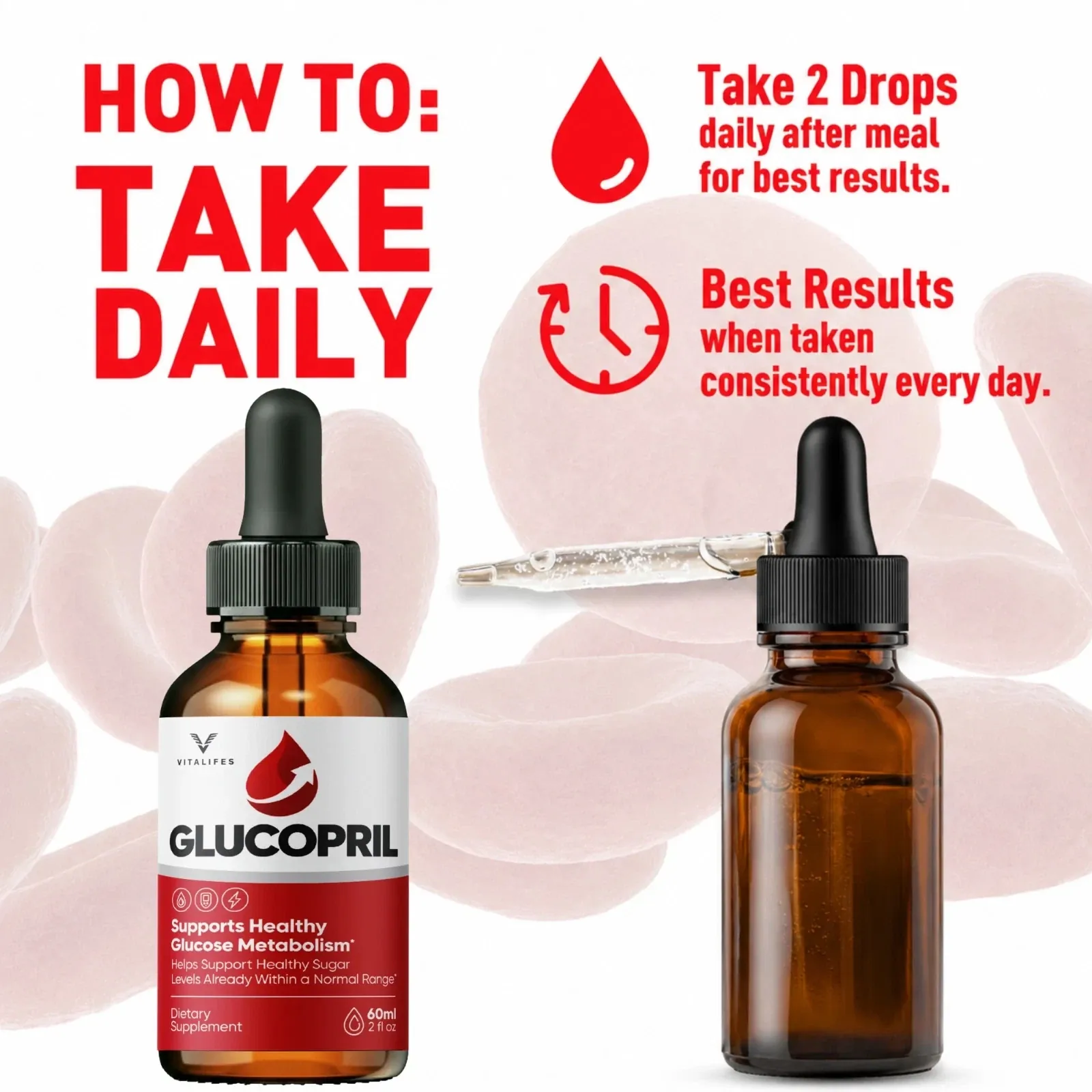
- A pharmacy dropper delivers roughly 0.05 ml a drop, so two drops is about a tenth of a millilitre.
- Drop size varies with viscosity, temperature, angle and squeeze, and three of those are outside your control.
- At two drops a day a 60 ml bottle covers several hundred days, which changes how a multi-bottle pack should be read.
- The trials behind these plants used weighed extracts at 50 mg to 1,200 mg a day.
- Consistency of technique matters more than precision, because the label asks for daily use rather than for a measured amount.
How big is a drop, really
There is a conventional answer and it is worth knowing before anything else. A standard pharmacy dropper is usually taken to deliver about twenty drops per millilitre, which puts a single drop at roughly 0.05 ml.
So two drops is about a tenth of a millilitre. That is a small volume by any measure, and for a botanical extract suspended in a carrier it means the quantity of plant material arriving is smaller still, because most of what falls is the carrier.
The conventional figure is also just that: a convention. It is an average across a lot of droppers and a lot of liquids, and any particular bottle can sit some way off it. Nobody using a dropper at home is measuring anything; they are counting, and counting a unit whose size they cannot check.
The five things that change one
A drop forms because surface tension holds liquid at the end of a tube until gravity wins. Everything that changes either side of that balance changes the size of what falls.
| What changes the size of a drop | Which direction it pushes | How much control you have |
|---|---|---|
| Viscosity of the liquid | Thicker liquid, larger drops | None |
| Temperature | Colder liquid is thicker, so drops grow | Some. Store it consistently |
| Angle of the dropper | Nearer vertical, smaller and more even drops | Complete |
| How hard the bulb is squeezed | Harder squeeze, faster and larger drops | Complete |
| How full the bottle is | A nearly empty bottle behaves differently | None |
Three of these five are outside a user's control, which is the honest reason a drop is an approximate unit rather than a precise one.
Two of those deserve a note. Temperature matters more than people expect: a bottle taken from a cold cupboard in January behaves measurably differently from the same bottle in August, because the liquid is thicker and holds on longer before releasing a larger drop. And the angle is the one most worth fixing, because it is entirely under your control and it is the largest single source of variation between one person’s technique and another’s.
What that means for a 60 ml bottle
Now the arithmetic, which is the most surprising thing on this page.
Sixty millilitres, at roughly 0.05 ml a drop, is about twelve hundred drops. At two drops a day that is somewhere around sixteen hundred days of dosing, which is well over four years. Even allowing generously for larger drops, spillage and the inch at the bottom that never quite comes out, a single bottle covers more than a year of daily use comfortably.
That has a direct consequence for anybody looking at a three-bottle or six-bottle ladder. A multi-bottle pack of a liquid dosed at two drops is not supply. It is storage, and the decision it represents is a commitment made on day one about a product you have taken for a week.
- Work out roughly how many days one bottle covers at the label dose.
- Compare that with how long the return window on your listing lasts.
- Compare both with how long you intend to take before judging anything.
- Buy the pack that fits the shortest of those three, not the longest.
Look at the GlucoPril ladder with the arithmetic done
Three packs, priced at the checkout, and a dose of two drops a day that makes a single bottle last considerably longer than most buyers assume.
Price at checkout · three bottles is the pack most buyers take · money-back guarantee as the listing prints it
Order GlucoPril On The Official WebsiteTwo drops a day after a meal · 60 ml a bottle · lot GLU-26/GO-3914
Why the research used weighed extracts
Every trial behind the plants on this label worked with a weighed, standardised extract, and that is not an accident of fashion.
The horse chestnut trial specified 50 mg of aescin twice daily, which is a statement about a particular fraction of a particular extract. The twelve-month gotu kola study used 60 mg of the total triterpenic fraction twice a day. The butcher’s broom meta-analysis assessed 150 mg of root extract per capsule alongside two named companions at stated amounts.
A trial has to know what it gave. If the quantity varies with the room temperature and the participant’s thumb, the result cannot be attributed to a dose, and a result that cannot be attributed to a dose cannot be replicated by anybody else. The bioavailability study of two horse chestnut formulations goes a step further and shows that even two weighed products can deliver different amounts of active to the circulation, which is how seriously this field takes the question.
None of that makes a dropper illegitimate. Tinctures have been used for centuries and plenty of people prefer them. It does mean that a liquid dosed by drops sits outside the comparison framework the research is built on, and that is a structural fact about the format rather than a complaint about any product.
The part of the liquid nobody talks about
Most of what falls out of a dropper is not plant extract. It is the carrier, the solvent the extracts are suspended in, and on a liquid supplement it is usually the great majority of the volume.
That carrier is a real ingredient with real consequences. It decides whether the product tastes of anything, how long it keeps once opened, whether it is suitable for somebody avoiding alcohol, and how the compounds behave in the bottle over a year on a shelf. Glycerine, ethanol, water and various oils all behave differently, and a tincture made with one is not interchangeable with a tincture made with another.
On a label with an other-ingredients line, the carrier is one row and takes five seconds to read. This product has no Supplement Facts panel at all, so the carrier is not named anywhere in the seller’s artwork. For most buyers that is a curiosity; for anybody avoiding alcohol, managing an allergy or buying for a household, it is the row they most wanted.
If the carrier matters to you for any reason, the order desk is the place to ask. A question asked before paying is answerable; the same question after the seal is broken is a returns conversation.
Six habits that make drops more consistent
If precision is not available, consistency is, and consistency is what the label actually asks for when it says best results come from taking it every day.
- Hold the dropper vertical rather than at an angle. This is the single largest improvement available.
- Squeeze slowly and let each drop form and fall on its own, rather than forcing a stream.
- Take it at the same time each day, after the same meal, so the routine stops requiring a decision.
- Store the bottle somewhere with a stable temperature, which keeps the viscosity, and so the drop size, roughly constant.
- Keep the dropper out of a glass, a spoon and your mouth. Returning a contaminated dropper to the bottle is how a liquid goes off early.
- Close the cap properly. An evaporating solvent concentrates whatever is left behind.
What a dropper is genuinely good at
Three things, and they are real advantages rather than consolation.
It is fast and it is easy to swallow, which matters more than it sounds for anybody who dislikes capsules or takes several other things each day. A liquid also begins dispersing immediately rather than waiting for a shell to break down, which is a genuine difference in how quickly a compound becomes available even if it rarely changes an outcome.
And the format encourages the behaviour the label asks for. A bottle on a kitchen counter with a visible dropper is a better daily prompt than a jar in a cupboard, and adherence is the variable that most often decides whether anybody experiences anything from a supplement at all. The distributor’s own roster is largely a set of reports about a routine that stuck.
What it is not good at is being compared with anything. The literature on how labels are read describes the assumptions a reader supplies when a quantity is missing, and a dropper bottle with no printed amount asks for more of those assumptions than almost any other format.
A dietary supplement for healthy adults of 18 and over, not a medicine and not FDA-approved. Follow the bottle: two drops daily after a meal, and no more than the label states. Nothing about dropper technique changes the two sentences the front of the bottle is permitted to print, and the page on taking it covers the routine in full.
References
- Kunz K, Lorkowski G, Petersen G, et al. Bioavailability of escin after administration of two oral formulations containing aesculus extract. Arzneimittelforschung. 1998;48(8):822-5. PMID 9748710. https://pubmed.ncbi.nlm.nih.gov/9748710/
- Incandela L, Belcaro G, Cesarone MR, et al. Treatment of diabetic microangiopathy and edema with total triterpenic fraction of Centella asiatica: a prospective, placebo-controlled randomized study. Angiology. 2001;52 Suppl 2:S27-31. PMID 11666119. Dose: TTFCA 60 mg twice daily for 12 months. https://pubmed.ncbi.nlm.nih.gov/11666119/
- Boyle P, Diehm C, Robertson C. Meta-analysis of clinical trials of Cyclo 3 Fort in the treatment of chronic venous insufficiency. Int Angiol. 2003;22(3):250-62. PMID 14612852. Dose: Ruscus aculeatus root extract 150 mg with hesperidin methyl chalcone 150 mg and ascorbic acid 100 mg per capsule; 10,246 subjects. https://pubmed.ncbi.nlm.nih.gov/14612852/
- Alsawadi A. The perception filler: a proposed conceptual framework for ingredient-interpretation gaps in food supplements. J Nutr. 2026;156(10):101803. PMID 42660500. https://pubmed.ncbi.nlm.nih.gov/42660500/
- Diehm C, Trampisch HJ, Lange S, Schmidt C. Comparison of leg compression stocking and oral horse-chestnut seed extract therapy in patients with chronic venous insufficiency. Lancet. 1996;347(8997):292-4. PMID 8569363. Dose: dried extract standardised to 50 mg aescin twice daily for 12 weeks in 240 patients; lower-leg volume fell 43.8 ml, against 46.7 ml for compression stockings. https://pubmed.ncbi.nlm.nih.gov/8569363/