GlucoPril Official Website › How It Works
How It WorksHow Does GlucoPril Work?
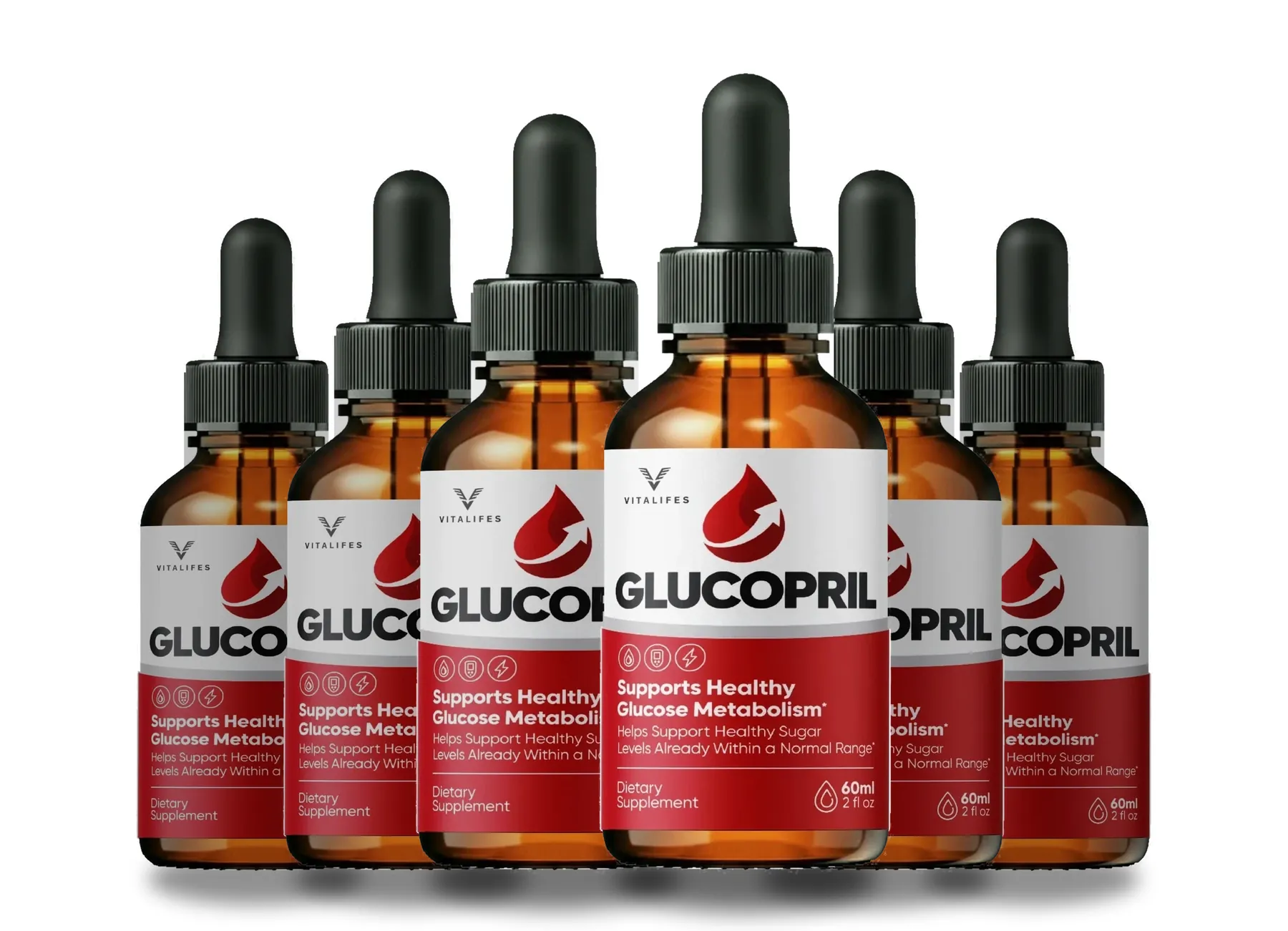
GlucoPril puts seven vascular botanicals into a carrier liquid, two drops at a time, after a meal.
The plants act, where they act, on vein walls and capillaries, which is what their trials measured. The step from a vessel to a blood sugar reading has been tested in three relevant trials and was not found in any of them.
Four steps in, three links that hold, and one that does not.
What happens to a GlucoPril drop after you swallow it?
Four steps, and the evidence thins out at the last one.
Two drops go onto the tongue or into a mouthful of water, and from there the journey is the ordinary one: mouth, stomach, small intestine, liver, bloodstream. A liquid skips the step a capsule cannot, which is the shell dissolving, so absorption starts earlier. That is the real advantage of the format and it is a modest one.
The label puts the dose after a meal. Food slows gastric emptying, which spreads absorption over a longer window, and it blunts the bitterness that seven concentrated botanical extracts bring with them. It also ties the dose to something that already happens every day, which is the single biggest predictor of whether a bottle gets finished.
What happens next is where the question actually lives. An absorbed compound has to reach a tissue, act on something there, and produce a change large enough for a home meter or a laboratory to see. Each of those steps is a separate claim, and the plants on this bottle have evidence for different ones.
Mouth and stomach
No shell to break down. Taken after food, the drops leave the stomach with the meal rather than ahead of it.
Small intestine
Where absorption happens. Aescin from horse chestnut is absorbed poorly and variably, which a formulation study measured directly, and it is why trials standardise the aescin rather than the extract weight.
Liver and bloodstream
First-pass metabolism takes a share of whatever arrives. What is left circulates and reaches vessel walls, which is where the venous work says these plants act.
A measurable change
The last step and the hardest. Leg volume can be measured in millilitres and blood pressure in millimetres of mercury. Blood sugar is measured too, and the trials that measured it are on the ingredients page.
What are the GlucoPril plants proposed to do inside a blood vessel?
Three proposed actions, all of them in the wall of a vessel.
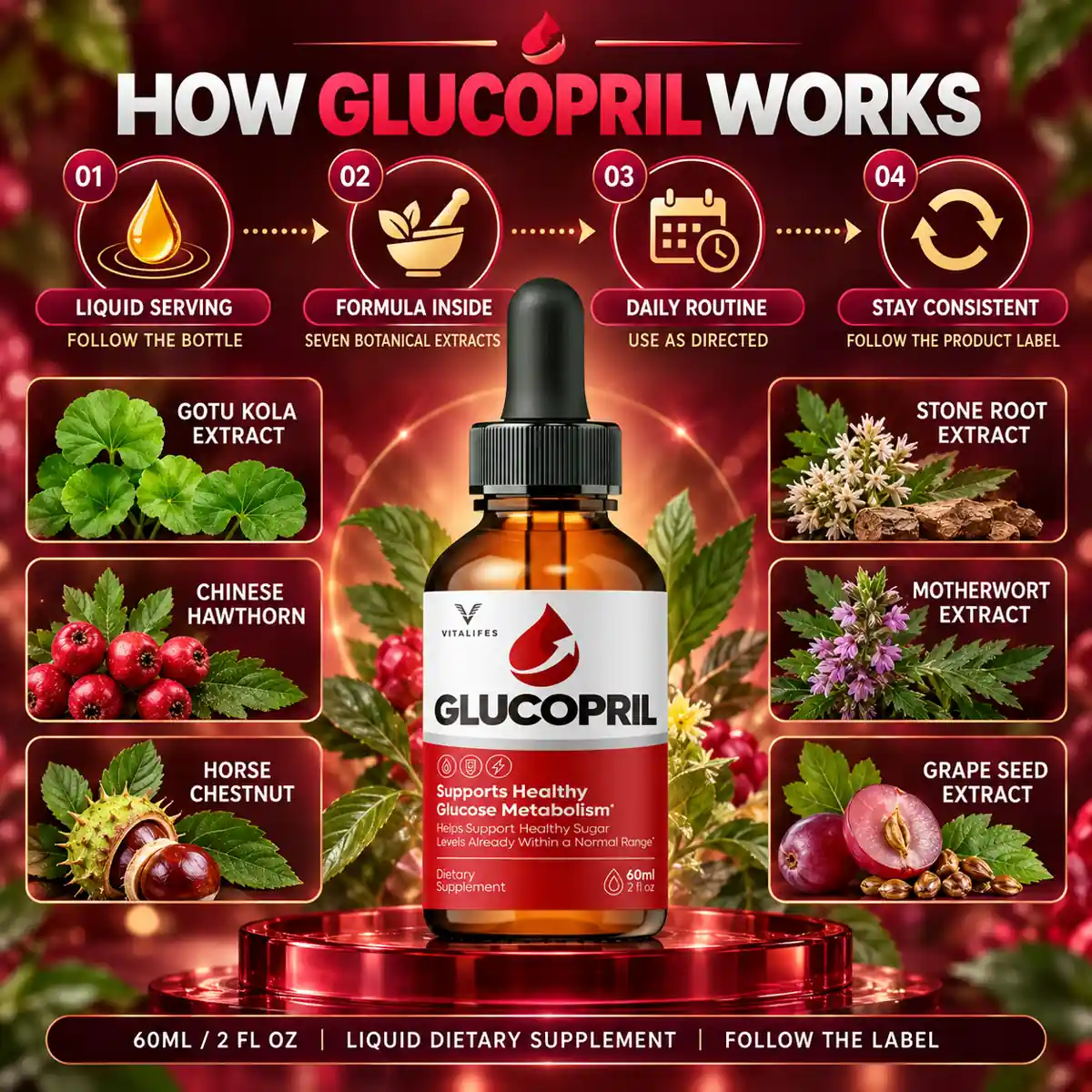
Phlebotonic is the pharmacological term for this family, and the proposed mechanism has three parts. Venous tone: the smooth muscle in a vein wall holds a little tighter, so blood pools less in a standing leg. Capillary permeability: the smallest vessels leak less fluid into surrounding tissue, which is why oedema is the outcome these trials measure. Endothelial and antioxidant effects: the cell layer lining a vessel behaves differently under the polyphenols these plants are rich in.
That third part is the one that touches the label's territory, because the endothelium is also where a great deal of metabolic trouble shows up first.
The evidence for the first two parts is real and it is specific. Cochrane's class review found moderate-certainty evidence that phlebotonics reduce oedema slightly, with a slight increase in adverse events alongside it. A meta-analysis of individual venous symptoms breaks the effect down further: heaviness, pain and the sensation of swelling all improved, and each by a modest amount.
So the mechanism is not speculative. It is well described, it has been measured many times, and it belongs to legs. The question for this bottle is whether any of it carries across to the claim printed on the front.
What would have to be true for GlucoPril to move a glucose reading?
A reasonable hypothesis, tested, with a result.
There is a plausible chain, and it is worth laying out properly rather than dismissing. Endothelial function and insulin sensitivity are connected: insulin reaches muscle through capillaries, and a vessel bed that responds poorly delivers it less efficiently. Polyphenols that improve endothelial behaviour could, in principle, improve that delivery. Grape seed is the strongest candidate on the bottle for exactly that argument.
Then the chain has to hold at every link, and that is where it strains. The 2023 cross-over trial built to test something close to this hypothesis gave 300 mg of grape seed extract with bilberry for twelve weeks to people at risk of type 2 diabetes. Blood pressure fell. The glucose measures did not move. Pooling the randomised trials puts fasting plasma glucose 2.01 mg/dL lower with HbA1c unchanged, an effect smaller than the day-to-day variation of a home meter.
Gotu kola was tested the same way and answered the same way. A six-month randomised trial at 1,200 mg a day in people with type 2 diabetes found no between-group difference in HbA1c or fasting glucose. Hawthorn, at 1,200 mg a day for sixteen weeks in a trial run specifically in people with diabetes, moved diastolic blood pressure and reported no glycaemic benefit.
| The link in the chain | How well it holds | What was measured |
|---|---|---|
| These plants reach the bloodstream | Well established for aescin, grape seed polyphenols and the gotu kola triterpenes | Pharmacokinetic studies |
| They act on vessel walls | Moderate-certainty evidence across the class | Leg volume, ankle circumference, capillary filtration |
| Vessel behaviour affects insulin delivery | Physiologically reasonable, not demonstrated for these plants | Nothing in this formula |
| A glucose reading changes | Tested three times in the relevant populations and not found | HbA1c, fasting plasma glucose |
The chain is intact for three links and breaks at the fourth, which is the one the front of the bottle is about.
Where does the GlucoPril mechanism story run out?
Three limits, stated once, in the section whose job they are.
Three limits are worth stating once, here, so that nothing else on this website has to keep raising them.
The first is arithmetic. Seven extracts share whatever the serving weighs, and no amount appears for any of them. The trial protocols on the ingredients page run from 60 mg twice daily to 1,200 mg a day. A serving that lands well below those figures would be expected to do less than the trials did, and nobody outside the factory can say where it lands.
The second is that combinations are not additive. A seven-plant formula has not been trialled as a formula, here or anywhere. What is known is what is known about each plant on its own, usually as a standardised single extract at a fixed dose, which is not the same object as a shared drop.
The third is the honest one about direction. Two of these plants lower blood pressure, and that is a documented effect rather than a suspicion. For most readers that is neutral or welcome. For a reader already on a blood pressure medicine it is the most important sentence on this page, and side effects handles it properly.
- The route in is ordinary, and a liquid starts absorbing sooner than a capsule.
- The proposed action is on vein walls and capillaries, and it is well described.
- The evidence for that action is moderate-certainty and the effect sizes are modest.
- The step from vessel behaviour to a glucose reading has been tested three times in the right populations and has not been found.
- No amount is given for any extract, so none of the trial doses can be matched to this bottle.
What the GlucoPril formula is realistically for
One bottle, two readings, and only one of them is well supported.
Read as a venous formula it is conventional and the ingredients make sense together. Read as a glucose formula it is asking a reader to accept a link that three trials looked for and did not find. Both readings are available from the same bottle, and which one a buyer takes home decides whether they are satisfied.
Public plain-language pages are the right place to check the general picture before any of this matters. NCCIH's page on diabetes and dietary supplements is direct about how little of this category has held up, and MedlinePlus on blood glucose explains what the numbers on a meter mean. Neither is selling anything.
Diabetes is diagnosed and managed by a clinician, and nothing on this website is a substitute for a prescription, a meter or a laboratory result.
Questions about how GlucoPril works
Does GlucoPril lower blood sugar?
The label does not claim that it lowers anything, and no trial of this combination exists. The two ingredients here that have been tested against a glucose endpoint, gotu kola and grape seed, left HbA1c where they found it in the trials described above.
How fast does GlucoPril start working?
Absorption of a liquid begins within minutes. That is a different question from when anything changes, and the trials behind these plants ran twelve weeks to two years. The results timeline sets the two clocks side by side.
Is the mechanism the same as berberine's?
No, and not close. Berberine's proposed route runs through AMPK activation and hepatic glucose output. The plants on this bottle act, where they act, on the wall of a vessel. They are two different pharmacologies aimed at two different organs.
Why does GlucoPril come as drops?
Liquids suit small doses of concentrated extract, skip the capsule shell, and let a manufacturer put seven extracts in one carrier. They also make an amount harder for a buyer to picture, which is the trade.
Would taking more make it work better?
Follow the bottle. Two drops daily after a meal is the printed direction, and taking more of a blend whose composition is not published is guesswork with a blood pressure effect attached to it.
Sources for the GlucoPril mechanism
Pharmacokinetics first, then the class evidence, then the three trials that tested the glucose link.
- Kunz K, Lorkowski G, Petersen G, et al. Bioavailability of escin after administration of two oral formulations containing aesculus extract. Arzneimittelforschung. 1998;48(8):822-5. PMID 9748710. https://pubmed.ncbi.nlm.nih.gov/9748710/
- Martinez-Zapata MJ, Vernooij RW, Simancas-Racines D, et al. Phlebotonics for venous insufficiency. Cochrane Database Syst Rev. 2020;11(11):CD003229. PMID 33141449. Sixty-nine randomised trials; moderate-certainty evidence that this whole class reduces oedema slightly and slightly increases adverse events. https://pubmed.ncbi.nlm.nih.gov/33141449/
- Kakkos SK, Allaert FA. Efficacy of Ruscus extract, HMC and vitamin C, constituents of Cyclo 3 fort, on improving individual venous symptoms and edema: a systematic review and meta-analysis of randomized double-blind placebo-controlled trials. Int Angiol. 2017;36(2):93-106. PMID 28225220. https://pubmed.ncbi.nlm.nih.gov/28225220/
- Grohmann T, Walker AW, Russell WR, et al. A grape seed and bilberry extract reduces blood pressure in individuals at risk of developing type 2 diabetes. Front Nutr. 2023;10:1139880. PMID 37351191. Dose: 300 mg grape seed extract with 250 mg bilberry daily for 12 weeks; blood pressure fell and glucose measures did not change. https://pubmed.ncbi.nlm.nih.gov/37351191/
- Asbaghi O, Nazarian B, Reiner Z, et al. The effects of grape seed extract on glycemic control, serum lipoproteins, inflammation, and body weight: a systematic review and meta-analysis of randomized controlled trials. Phytother Res. 2020;34(2):239-53. PMID 31880030. Fasting plasma glucose fell 2.01 mg/dL (95% CI -3.14 to -0.86); HbA1c did not change. https://pubmed.ncbi.nlm.nih.gov/31880030/
- Tawanwongsri W, Mordmuang A, Phenwan T, Siri-Archawawat D. Efficacy and safety of Centella asiatica (L.) Urb. [Apiaceae] as a dietary supplement for glycemic control and lipid regulation in patients with type 2 diabetes: a randomized controlled trial in Thailand. Front Pharmacol. 2025;16:1680647. PMID 41383475. Dose: 1,200 mg/day for 6 months; adjusted analysis found no between-group difference in HbA1c, fasting plasma glucose or LDL-C. https://pubmed.ncbi.nlm.nih.gov/41383475/
- Walker AF, Marakis G, Simpson E, et al. Hypotensive effects of hawthorn for patients with diabetes taking prescription drugs: a randomised controlled trial. Br J Gen Pract. 2006;56(527):437-43. PMID 16762125. Dose: 1,200 mg hawthorn extract daily for 16 weeks in 79 people with type 2 diabetes; diastolic blood pressure fell, and the trial did not report a glycaemic benefit. https://pubmed.ncbi.nlm.nih.gov/16762125/
- MedlinePlus, U.S. National Library of Medicine. Blood Glucose. Read 19 September 2026. https://medlineplus.gov/bloodglucose.html
- National Center for Complementary and Integrative Health. Diabetes and Dietary Supplements: What You Need To Know. Read 19 September 2026. https://www.nccih.nih.gov/health/diabetes-and-dietary-supplements-what-you-need-to-know
Order GlucoPril knowing which mechanism it has evidence for
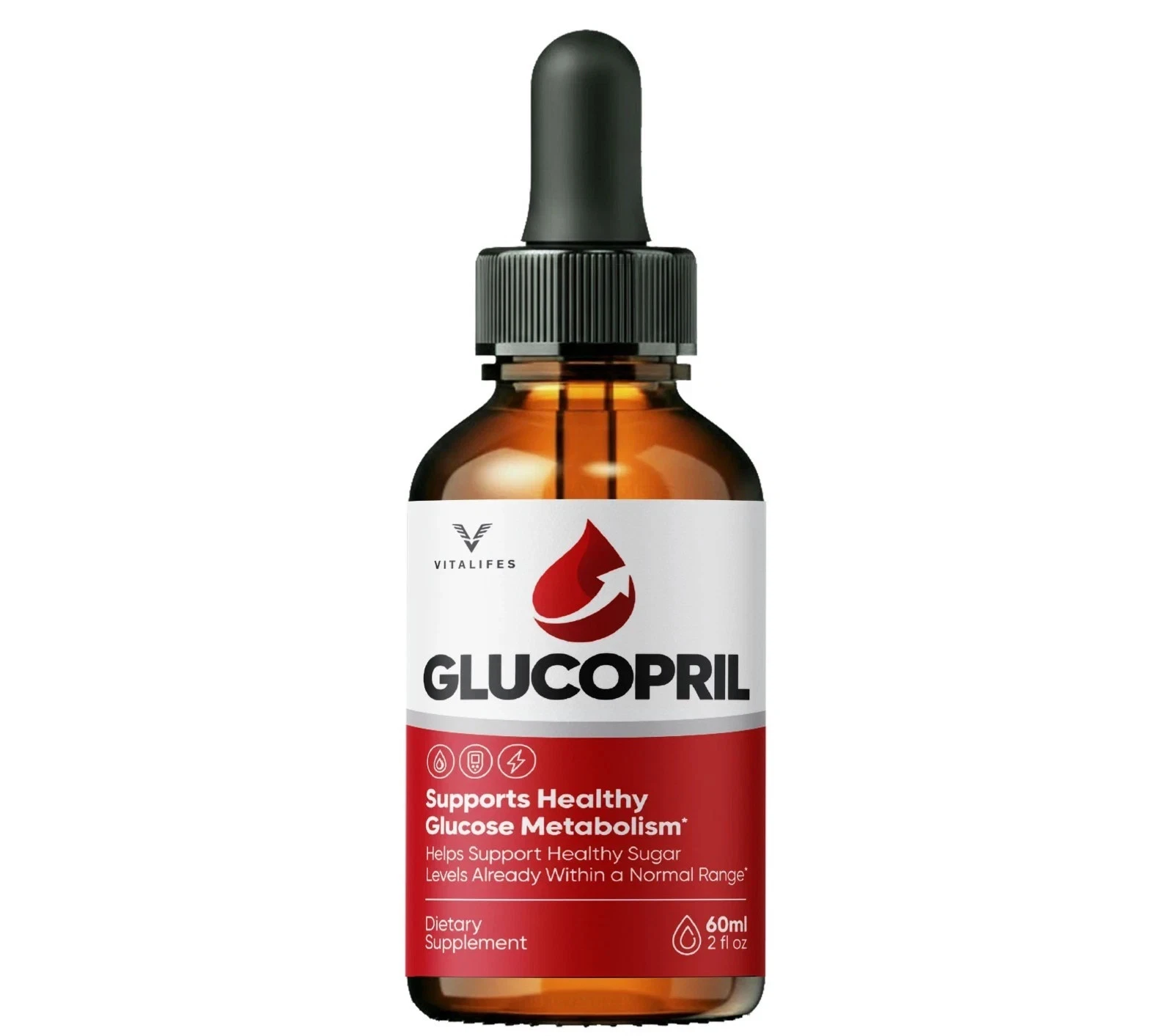
Two drops a day after a meal, seven named extracts, and a vascular research file you can read for yourself.
Price at checkout · three bottles is the pack most buyers take · money-back guarantee as the listing prints it
Order GlucoPril On The Official WebsiteTwo drops a day after a meal · 60 ml a bottle · lot GLU-26/GO-3914