GlucoPril Official Website › Ingredients
IngredientsGlucoPril Ingredients
Seven botanical extracts are named on the GlucoPril artwork and no amount appears beside any of them.
Gotu kola, Chinese hawthorn, horse chestnut, stone root, motherwort, butcher's broom and grape seed. Every one of the seven comes from the vein and capillary research field, and each card below prints the daily amount its own trials ran at.
Seven names, seven research files, and the amount behind each one.
The GlucoPril ingredient artwork
Where the list comes from, before anything is said about it.
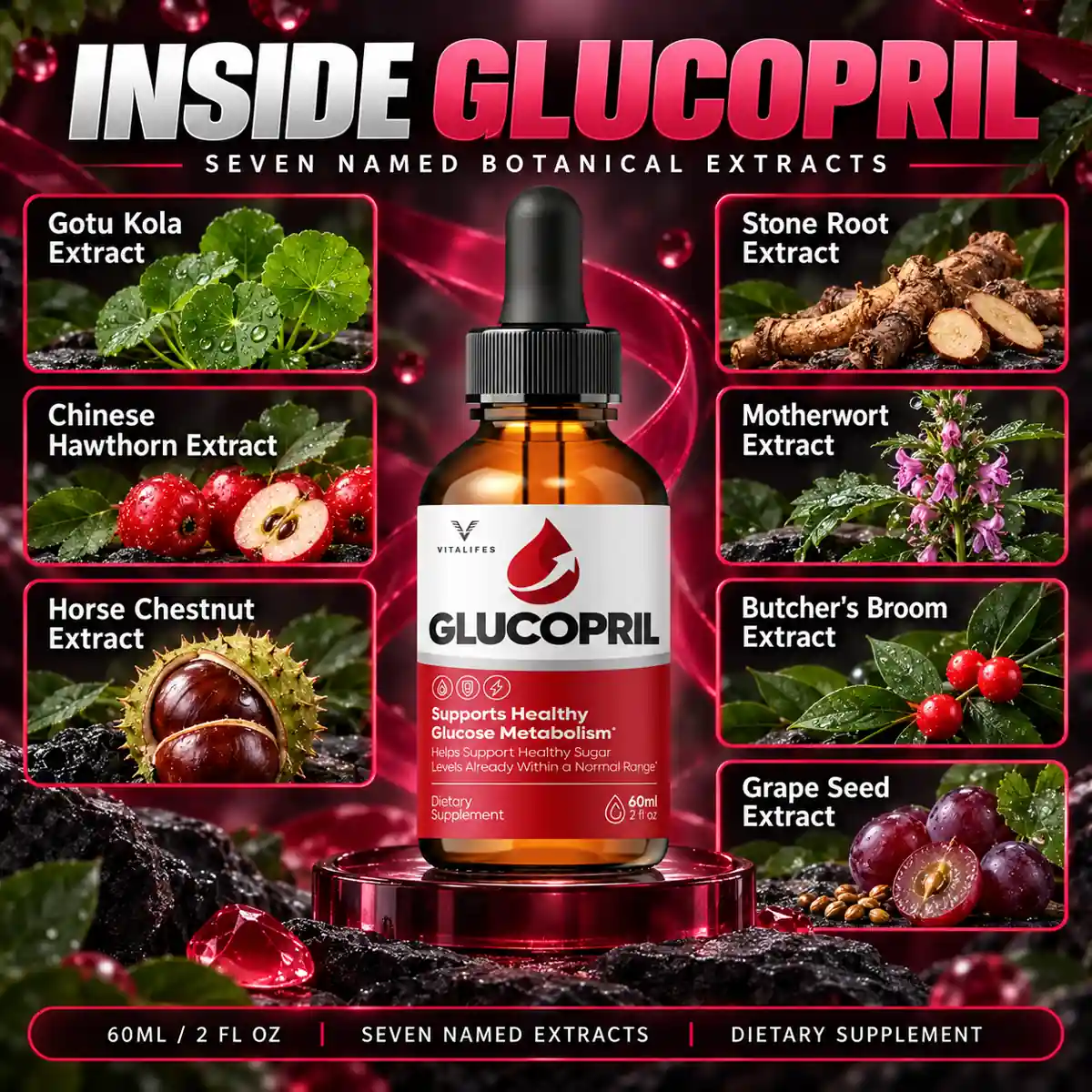
The seller's square graphic is where the seven names live. It gives the plant, sometimes the part, and nothing numerical. The bottle front carries the two claims and the 60 ml fill, and the two surfaces between them are the whole published description of what is inside.
Read alongside the trial doses on this page, the graphic answers what is in it and leaves how much open.
What is named on the GlucoPril ingredient graphic?
Seven plants, seven research files, and what each file was actually about.
Seven extracts, in the order the seller's own square artwork prints them. Each card below carries the plant, the part used, and the daily amount the published trials put behind it, so the two can be read together rather than one at a time.
Gotu Kola Extract
Centella asiatica, leafNo amount printed · trials ran 60 mg twice daily to 1,200 mg a dayA creeping marsh plant used across South and Southeast Asia, and the only name on this bottle that has been taken into a modern diabetes ward and measured. A Thai randomised trial published in 2025 gave 1,200 mg a day for six months to people with type 2 diabetes and found no difference between the groups in HbA1c, fasting plasma glucose or LDL cholesterol. Its older reputation is vascular: a twelve-month study used 60 mg of the purified triterpene fraction twice a day for swelling and capillary leak in diabetic microangiopathy, and a 2013 systematic review of eight trials reports improved microcirculatory measures in tired, heavy legs.
Chinese Hawthorn Extract
Crataegus pinnatifida, fruitNo amount printed · trials ran 900 mg to 5,000 mg a dayA red autumn berry that European and Chinese cardiology have both taken seriously for a century. The trial closest to this label is a Reading study in 79 people with type 2 diabetes, 1,200 mg a day for sixteen weeks, which lowered diastolic blood pressure and reported no glycaemic benefit. The heart-failure programme behind the plant used the WS 1442 extract at 900 mg a day, and the SPICE trial in 2,681 patients over two years missed its primary endpoint. Hawthorn is also the one name here with a measured drug interaction, which side effects sets out.
Horse Chestnut Extract
Aesculus hippocastanum, seedNo amount printed · trials ran 50 mg of aescin twice dailyThe conker tree, standardised to a saponin mixture called aescin, and one of the best-evidenced plants in the whole venous field. A 1996 Lancet comparison in 240 patients gave 50 mg of aescin twice a day for twelve weeks and took 43.8 ml off the lower leg, against 46.7 ml for compression stockings. Cochrane's review pooled six placebo-controlled trials at a weighted mean of 32.1 ml. Every one of those numbers is a leg volume. A search for this extract against a blood-sugar outcome returns nothing.
Stone Root Extract
Collinsonia canadensis, rootNo amount printed · no human trial exists at any amountA North American mint-family root with a long folk history in haemorrhoids and varicose veins, and the thinnest evidence base on the bottle. PubMed holds seven records for the entire genus. Two are an 1887 British Medical Journal note and an 1888 Southern Medical Record entry, one is a 1999 flavanone isolation, and one is a 2014 cell-line screen done in a dish rather than in people. That is the whole file. Its place in this formula is traditional venous practice, which is a reason without being evidence.
Motherwort Extract
Leonurus cardiacaNo amount printed · no randomised metabolic trial existsA tall square-stemmed plant whose Latin name carries the heart in it, traditionally given for palpitations and anxiety. A 2013 phytochemistry and pharmacology review collects the alkaloids, iridoids and diterpenes behind that use. The clinical literature that does exist is obstetric: a 2025 meta-analysis studies motherwort alongside oxytocin after delivery, and a 2024 laboratory paper shows coumarins from the related species acting in opposite directions on uterine muscle. That is why this bottle is kept away from pregnancy.
Butcher’s Broom Extract
Ruscus aculeatus, rootNo amount printed · trials ran 150 mg of extract per capsuleA spiny Mediterranean shrub, and the active half of the combination European pharmacies sell for heavy legs. A meta-analysis covering 10,246 subjects assessed 150 mg of the root extract with 150 mg of hesperidin methyl chalcone and 100 mg of vitamin C in one capsule, which is how it is almost always studied. A placebo-controlled trial in 2002 ran twelve weeks and improved leg volume and symptoms. Pointed at the eye instead of the leg, a Cochrane review of single herbs in diabetic retinopathy found no usable evidence.
Grape Seed Extract
Vitis vinifera, seedNo amount printed · trials ran 100 mg to 300 mg a dayA proanthocyanidin concentrate, and the second of the two names here that anyone has aimed at glucose. A 2023 cross-over trial in people at risk of type 2 diabetes gave 300 mg with bilberry daily for twelve weeks: blood pressure came down and the glucose measures stayed where they were. A meta-analysis of randomised trials puts the fasting glucose effect at 2.01 mg/dL with HbA1c unmoved, which is real and is smaller than the width of most home meters. Sixteen trials pooled for blood pressure point the same way as the first study: this is a vascular ingredient.
Why do the seven GlucoPril extracts belong to one pharmacy shelf?
The combination is not random. It is a recognised category with a name.
Put the seven names in front of a European vascular pharmacist and they will be recognised instantly, because they are the standard set for heavy, aching, swollen legs. Horse chestnut and butcher's broom are the two the continent has sold for decades. Gotu kola sits beside them for capillary leak. Grape seed and hawthorn carry the vessel-wall and blood-pressure work. Stone root and motherwort are the older traditional members of the same category.
Cochrane treats them as a single class and calls it phlebotonics. The 2020 review of 69 randomised trials concluded, at moderate certainty, that the class reduces oedema slightly and slightly increases side effects. That is the shelf this bottle was assembled from, and it explains the formula better than anything on the front of the label does.
None of that makes the combination a poor one. It makes it a specific one, with its own research and its own intended reader. What how it works does is follow that thread through to the claim on the front.
| Extract | The research field it comes from | The outcome the trials measured |
|---|---|---|
| Gotu kola | Microcirculation and capillary permeability | Ankle oedema, capillary filtration rate |
| Chinese hawthorn | Cardiology and blood pressure | Diastolic blood pressure, heart-failure endpoints |
| Horse chestnut | Venous insufficiency | Lower-leg volume in millilitres |
| Stone root | Traditional venous practice | Nothing measured in a controlled trial |
| Motherwort | Traditional cardiac and obstetric practice | Postpartum blood loss, uterine muscle tone |
| Butcher’s broom | Venous insufficiency | Leg volume, ankle circumference |
| Grape seed | Cardiovascular risk markers | Systolic and diastolic blood pressure, lipids |
Two of the seven have ever been pointed at a blood-sugar endpoint, and both are described on their own cards above.
How much of each plant is in a GlucoPril drop?
The one section on this page whose job is the gap.
The seller's ingredient graphic gives seven names and stops there, and no artwork in this pack carries a Supplement Facts panel of any kind. Every bottle photograph the seller supplies is a front view. So the honest position is that the split between the seven is unknown, and the table below sets each plant against the amount its own research ran at rather than against a figure from the bottle.
A figure of roughly 121 mg for the whole blend circulates in marketplace listings for this product. It reaches this desk as a marketplace report with no panel behind it, and it is printed here in that form only. Read it as a report, and notice what it would mean if it were right: 121 milligrams shared between seven extracts averages about 17 mg each, against trial protocols that start at 60 mg and run to 1,200 mg.
That comparison is the reason these pages print trial doses at all. It is not an accusation, because nobody outside the factory can confirm the split. It is the only arithmetic available to a buyer holding the bottle.
A photograph of the back of the bottle. If a Supplement Facts panel exists on the physical label, it carries the serving size, the blend weight and whatever amounts the manufacturer chose to break out. Anyone who has the bottle in their hand can answer in one picture what no amount of reading the front will settle.
What else is in a GlucoPril bottle besides the seven extracts?
Actives are the smaller part of any liquid supplement.
A liquid supplement is mostly not its actives. Something has to hold the extracts in suspension, keep them stable in an opened bottle for months, and let a dropper release an even bead. In this category that is usually vegetable glycerine, a food-grade alcohol, purified water, or a blend of the three, sometimes with a trace of natural flavour over the top.
The front label names none of it, and there is no other-ingredients line to read because there is no back-panel photograph in the pack. This matters more than it sounds. The carrier decides whether the drops taste of anything, whether the bottle suits someone avoiding alcohol, and how long the contents last once the seal is broken.
Two practical consequences follow. Anyone avoiding alcohol on religious, medical or personal grounds should ask the order desk before ordering rather than after. And anyone expecting the drops to be tasteless should expect the opposite: seven botanical extracts in a small volume are bitter, which is why the label puts the dose after a meal.
- The bottle is 60 ml of amber glass with a pipette in the cap, and amber glass is a light barrier rather than decoration.
- Two drops is the whole serving, so the fill lasts a long time and the cap gets opened many times.
- Store it upright, somewhere dark and dry, away from a windowsill and away from the steam above a kettle.
- The carrier, the flavour and any preservative are unnamed on the front of the label, and the order desk is the only route to an answer.
- Lot GLU-26/GO-3914 is on the base of the bottle when the bottle shows it, and batch verify explains what that reference does.
Which blood sugar botanicals are absent from GlucoPril?
What a shopper in this aisle expected to find, and did not.
Shoppers in this aisle arrive with a short list of names in mind, and none of them is on this bottle. Berberine, cinnamon, chromium, gymnema, bitter melon, banaba and alpha lipoic acid are the ingredients that built the category, and the seven extracts here belong to a different literature entirely.
The comparison is worth making honestly in both directions. An umbrella meta-analysis of berberine and an umbrella review of cinnamon both report measurable glycaemic effects, and both come with the usual caveats about trial quality, heterogeneity and the size of the change. Those ingredients also bring their own interaction lists, and berberine in particular is not a casual purchase alongside prescribed medicine.
What can be said cleanly is this: a buyer who wanted the mainstream glycaemic shelf and bought this bottle has bought something else. A buyer who wanted a vein and capillary formula has bought a conventional one. Who it is for works through which of those you are.
What the GlucoPril ingredient list does well
- Seven named extracts rather than a blend hidden behind one invented trade name.
- The plant part is given for four of the seven, including the root of stone root and of butcher's broom, which is the part the research used.
- Horse chestnut, butcher's broom and gotu kola all have real controlled trials behind them within their own field.
- The serving is two drops, which is easy to take consistently and hard to double by accident.
What the GlucoPril ingredient list leaves open
- No amount appears beside any of the seven, so the split between them cannot be checked by anybody.
- Stone root and motherwort bring no controlled human evidence to the mix at any dose.
- The front of the label sells glucose metabolism and the formula comes off the venous shelf.
- The carrier liquid is unnamed, which matters to anyone avoiding alcohol.
GlucoPril ingredient questions
How many ingredients does GlucoPril have?
Seven botanical extracts are named on the seller's ingredient graphic: gotu kola, Chinese hawthorn, horse chestnut, stone root, motherwort, butcher's broom and grape seed. The pack's own list and the graphic agree exactly, which is less common than it should be.
Does GlucoPril contain berberine or cinnamon?
Neither, and no chromium, gymnema, bitter melon or banaba either. The seven names on this bottle come from the venous and capillary literature rather than the glycaemic one.
Which extract has the strongest research behind it?
Horse chestnut, on volume of evidence. A Lancet comparison against compression stockings and a Cochrane review of six placebo-controlled trials both measured the same thing: millilitres of swelling off a lower leg. None of that work was about blood sugar.
Is the stone root the root, or the leaf?
The root, which the pack states and which is the part with the traditional record. It makes no difference to the evidence: the whole genus has seven entries in PubMed and not one controlled trial in people.
Is GlucoPril vegan, and is there alcohol in it?
The front label carries neither statement, and there is no other-ingredients line in the artwork to read. The liquid has to be carried in something, usually glycerine, alcohol or water. Call the order desk before ordering if either answer decides the purchase for you.
Do the seven extracts interact with each other?
Two of them move blood pressure in the same direction, so their effects are unlikely to cancel. Beyond that, a seven-plant combination has not been trialled as a combination by anybody, here or elsewhere, so what is known is what is known about each plant alone.
Sources for the GlucoPril ingredient list
Grouped by plant, in the order the seller's graphic prints them.
- Tawanwongsri W, Mordmuang A, Phenwan T, Siri-Archawawat D. Efficacy and safety of Centella asiatica (L.) Urb. [Apiaceae] as a dietary supplement for glycemic control and lipid regulation in patients with type 2 diabetes: a randomized controlled trial in Thailand. Front Pharmacol. 2025;16:1680647. PMID 41383475. Dose: 1,200 mg/day for 6 months; adjusted analysis found no between-group difference in HbA1c, fasting plasma glucose or LDL-C. https://pubmed.ncbi.nlm.nih.gov/41383475/
- Chong NJ, Aziz Z. A systematic review of the efficacy of Centella asiatica for improvement of the signs and symptoms of chronic venous insufficiency. Evid Based Complement Alternat Med. 2013;2013:627182. PMID 23533507. Eight trials; microcirculatory measures improved, most studies at unclear risk of bias. https://pubmed.ncbi.nlm.nih.gov/23533507/
- Incandela L, Belcaro G, Cesarone MR, et al. Treatment of diabetic microangiopathy and edema with total triterpenic fraction of Centella asiatica: a prospective, placebo-controlled randomized study. Angiology. 2001;52 Suppl 2:S27-31. PMID 11666119. Dose: TTFCA 60 mg twice daily for 12 months. https://pubmed.ncbi.nlm.nih.gov/11666119/
- Walker AF, Marakis G, Simpson E, et al. Hypotensive effects of hawthorn for patients with diabetes taking prescription drugs: a randomised controlled trial. Br J Gen Pract. 2006;56(527):437-43. PMID 16762125. Dose: 1,200 mg hawthorn extract daily for 16 weeks in 79 people with type 2 diabetes; diastolic blood pressure fell, and the trial did not report a glycaemic benefit. https://pubmed.ncbi.nlm.nih.gov/16762125/
- Holubarsch CJ, Colucci WS, Meinertz T, et al. The efficacy and safety of Crataegus extract WS 1442 in patients with heart failure: the SPICE trial. Eur J Heart Fail. 2008;10(12):1255-63. PMID 19019730. Dose: WS 1442 900 mg/day for 24 months in 2,681 patients; no significant effect on the primary endpoint. https://pubmed.ncbi.nlm.nih.gov/19019730/
- Pittler MH, Ernst E. Horse chestnut seed extract for chronic venous insufficiency. Cochrane Database Syst Rev. 2012;11(11):CD003230. PMID 23152216. Leg volume fell by a weighted mean 32.1 ml against placebo across six trials; the authors call for larger definitive trials. https://pubmed.ncbi.nlm.nih.gov/23152216/
- Diehm C, Trampisch HJ, Lange S, Schmidt C. Comparison of leg compression stocking and oral horse-chestnut seed extract therapy in patients with chronic venous insufficiency. Lancet. 1996;347(8997):292-4. PMID 8569363. Dose: dried extract standardised to 50 mg aescin twice daily for 12 weeks in 240 patients; lower-leg volume fell 43.8 ml, against 46.7 ml for compression stockings. https://pubmed.ncbi.nlm.nih.gov/8569363/
- Shoemaker JV. Collinsonia Canadensis. Br Med J. 1887;2(1396):712-3. PMID 20752052. https://pubmed.ncbi.nlm.nih.gov/20752052/
- Collinsonia Canadensis. South Med Rec. 1888;18(4):136. PMID 36022907. https://pubmed.ncbi.nlm.nih.gov/36022907/
- Stevens JF, Ivancic M, Deinzer ML, et al. A novel 2-hydroxyflavanone from Collinsonia canadensis. J Nat Prod. 1999;62(2):392-4. PMID 10075799. https://pubmed.ncbi.nlm.nih.gov/10075799/
- Mazzio E, Badisa R, Mack N, et al. High throughput screening of natural products for anti-mitotic effects in MDA-MB-231 human breast carcinoma cells. Phytother Res. 2014;28(6):856-67. PMID 24105850. A laboratory screen, not a study in people. https://pubmed.ncbi.nlm.nih.gov/24105850/
- Wojtyniak K, Szymanski M, Matlawska I. Leonurus cardiaca L. (motherwort): a review of its phytochemistry and pharmacology. Phytother Res. 2013;27(8):1115-20. PMID 23042598. https://pubmed.ncbi.nlm.nih.gov/23042598/
- Chen C, Liu Q, Lu Y, et al. Motherwort synergized with oxytocin for postpartum hemorrhage prevention: integrated clinical efficacy and mechanism exploration. Phytomedicine. 2025;145:156951. PMID 40527062. https://pubmed.ncbi.nlm.nih.gov/40527062/
- Fan Y, Liu C, Wang F, et al. Coumarins with different substituents from Leonurus japonicus have opposite effects on uterine smooth muscle. Int J Mol Sci. 2024;25(18). PMID 39337649. https://pubmed.ncbi.nlm.nih.gov/39337649/
- Vanscheidt W, Jost V, Wolna P, et al. Efficacy and safety of a Butcher's broom preparation (Ruscus aculeatus L. extract) compared to placebo in patients suffering from chronic venous insufficiency. Arzneimittelforschung. 2002;52(4):243-50. PMID 12040966. Dose: the manufacturer's recommended daily dosage for 12 weeks; leg volume and symptoms improved against placebo. https://pubmed.ncbi.nlm.nih.gov/12040966/
- Boyle P, Diehm C, Robertson C. Meta-analysis of clinical trials of Cyclo 3 Fort in the treatment of chronic venous insufficiency. Int Angiol. 2003;22(3):250-62. PMID 14612852. Dose: Ruscus aculeatus root extract 150 mg with hesperidin methyl chalcone 150 mg and ascorbic acid 100 mg per capsule; 10,246 subjects. https://pubmed.ncbi.nlm.nih.gov/14612852/
- Zhang HW, Zhang H, Grant SJ, et al. Single herbal medicine for diabetic retinopathy. Cochrane Database Syst Rev. 2018;12(12):CD007939. PMID 30566763. https://pubmed.ncbi.nlm.nih.gov/30566763/
- Grohmann T, Walker AW, Russell WR, et al. A grape seed and bilberry extract reduces blood pressure in individuals at risk of developing type 2 diabetes. Front Nutr. 2023;10:1139880. PMID 37351191. Dose: 300 mg grape seed extract with 250 mg bilberry daily for 12 weeks; blood pressure fell and glucose measures did not change. https://pubmed.ncbi.nlm.nih.gov/37351191/
- Asbaghi O, Nazarian B, Reiner Z, et al. The effects of grape seed extract on glycemic control, serum lipoproteins, inflammation, and body weight: a systematic review and meta-analysis of randomized controlled trials. Phytother Res. 2020;34(2):239-53. PMID 31880030. Fasting plasma glucose fell 2.01 mg/dL (95% CI -3.14 to -0.86); HbA1c did not change. https://pubmed.ncbi.nlm.nih.gov/31880030/
- Zhang H, Liu S, Li L, et al. The impact of grape seed extract treatment on blood pressure changes: a meta-analysis of 16 randomized controlled trials. Medicine (Baltimore). 2016;95(33):e4247. PMID 27537554. https://pubmed.ncbi.nlm.nih.gov/27537554/
- Martinez-Zapata MJ, Vernooij RW, Simancas-Racines D, et al. Phlebotonics for venous insufficiency. Cochrane Database Syst Rev. 2020;11(11):CD003229. PMID 33141449. Sixty-nine randomised trials; moderate-certainty evidence that this whole class reduces oedema slightly and slightly increases adverse events. https://pubmed.ncbi.nlm.nih.gov/33141449/
- Nazari A, Ghotbabadi ZR, Kazemi KS, et al. The effect of berberine supplementation on glycemic control and inflammatory biomarkers in metabolic disorders: an umbrella meta-analysis. Clin Ther. 2024;46(2):e64-e72. PMID 38016844. https://pubmed.ncbi.nlm.nih.gov/38016844/
- Zarezadeh M, Musazadeh V, Foroumandi E, et al. The effect of cinnamon supplementation on glycemic control in patients with type 2 diabetes or with polycystic ovary syndrome: an umbrella meta-analysis. Diabetol Metab Syndr. 2023;15(1):127. PMID 37316893. https://pubmed.ncbi.nlm.nih.gov/37316893/
Order GlucoPril with the seven names in front of you
Two drops a day after a meal, 60 ml of amber glass a bottle, and the same seven extracts in every one of them.
Price at checkout · three bottles is the pack most buyers take · money-back guarantee as the listing prints it
Order GlucoPril On The Official WebsiteTwo drops a day after a meal · 60 ml a bottle · lot GLU-26/GO-3914