GlucoPril Official Website › Blog › Butcher's Broom
Butcher's Broom Against A Placebo Capsule
This is the second name on the label with a real placebo-controlled trial behind it, not just a review of horse chestnut’s cousin literature. A German multi-centre study gave 166 women a Ruscus extract or a placebo capsule for twelve weeks and measured their legs. Here is exactly what it found, and what a later ten-trial review added to it.
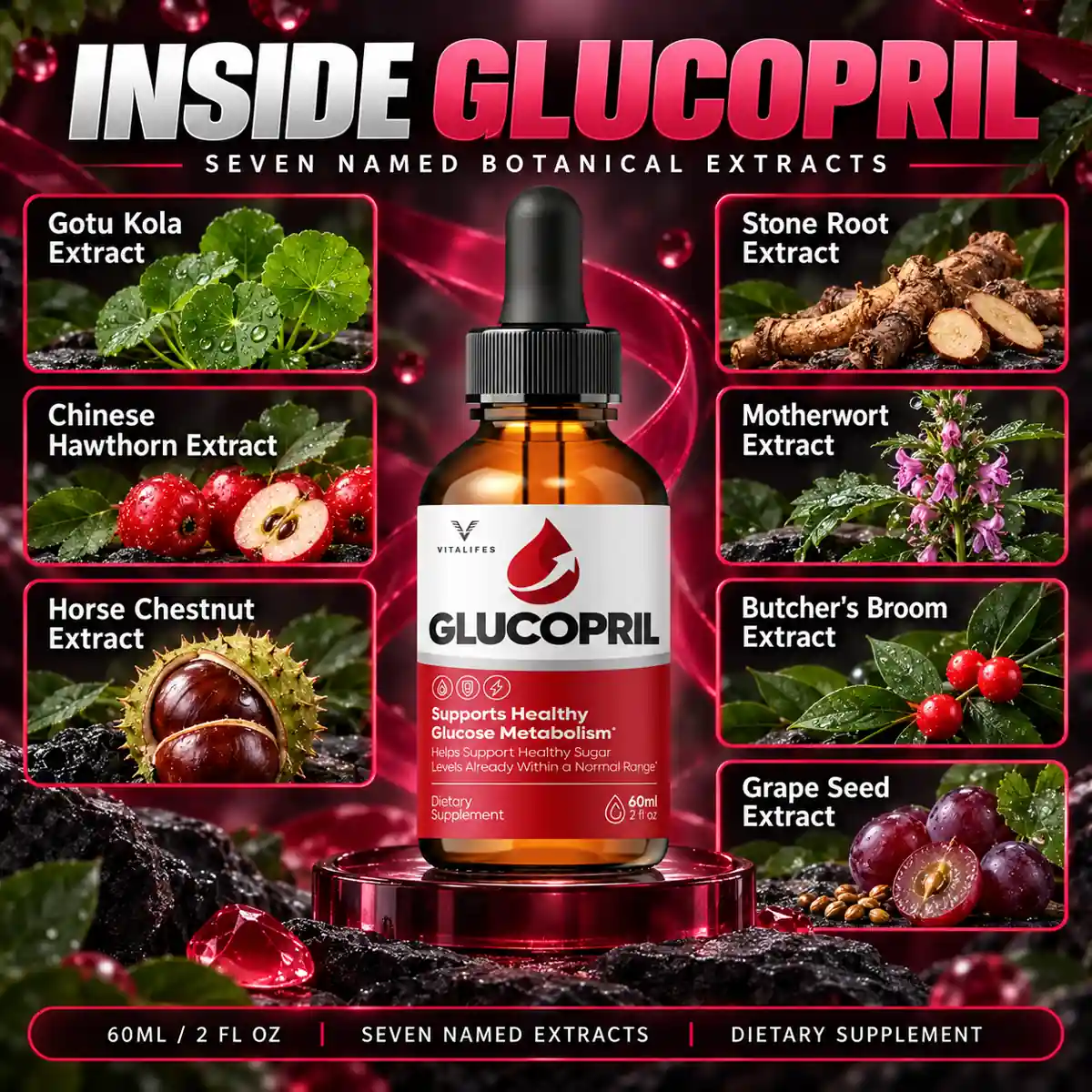
- Butcher's broom is Ruscus aculeatus, and the part every trial below used is the rhizome, the underground stem.
- A 2002 German trial randomised 166 women with chronic venous insufficiency to Ruscus extract or placebo for 12 weeks; 148 completed it.
- Leg volume fell 16.5 ml at 8 weeks and 20.5 ml at 12 weeks more than placebo, at the dose set by the German drug monograph for this extract.
- A 2017 systematic review pooled ten placebo-controlled trials and 719 patients and found Ruscus reduced ankle circumference and leg or foot volume, among other venous symptoms.
- Every outcome in both papers is a leg measurement. Neither tested a blood sugar outcome, and this is the second ingredient on the label, after horse chestnut, with a trial this direct behind it.
The rhizome, and why the part matters
Ruscus aculeatus is a low, spiky evergreen shrub native to the Mediterranean and western Europe, and the part used medicinally is the rhizome: the thick underground stem, not the spiky above-ground leaves that give the plant its common names, butcher’s broom and knee holly. The rhizome contains steroidal saponins, chiefly ruscogenins, which are the compounds the pharmacology points to.
This label names Butcher’s Broom Extract without specifying the rhizome, which puts it in the same position as most of the other six names on this bottle: a plant is named, and the part, the standardisation and the amount are left for a reader to chase down. Every trial cited below used the rhizome specifically, so that is the material this article’s findings apply to.
166 women and a placebo capsule
A 2002 multi-centre trial published in Arzneimittelforschung set out to confirm Ruscus extract’s efficacy against a genuine placebo, which sounds like an obvious design and is in fact the harder test: horse chestnut’s most famous trial was measured against compression stockings, a mechanical comparator that both arms could feel working. A placebo capsule gives no such cue, so any real difference has to come from the extract.
166 women with chronic venous insufficiency, Widmer grade I or II, were randomised to Ruscus extract or an identical placebo capsule. 148 were eligible for the intent-to-treat analysis, with an average disease duration of about 15 years in both groups. The primary measure was the area under the curve of leg volume change over 12 weeks, and it reached statistical significance in favour of the extract.
Translated into the numbers a reader can hold onto: leg volume fell 16.5 ml more than placebo at 8 weeks, and 20.5 ml more at 12 weeks. Ankle and leg circumference improved on the same schedule, and subjective symptoms — heavy, tired legs and a sensation of tension — improved by week 12 and correlated with the volume change. Overall efficacy, assessed by the investigators, favoured the extract significantly.
| The study | What it compared | What it reported |
|---|---|---|
| The 2002 German trial, 166 randomised, 148 analysed | Ruscus rhizome extract against an identical placebo capsule, 12 weeks | Leg volume fell 16.5 ml (8 wks) and 20.5 ml (12 wks) more than placebo |
| 2017 systematic review, 10 trials, 719 patients | Ruscus extracts against placebo, across defined venous symptoms | Ankle circumference SMD −0.74; leg/foot volume SMD −0.61; pain, heaviness and swelling all improved |
| A single published case report | Lymphocytic colitis in a patient on a Ruscus-containing combination product | One case, no causal link established, worth knowing about |
Every outcome in this table is a leg volume, a circumference or a symptom score. None of them is a glucose reading.
See where butcher's broom sits among the GlucoPril seven
Sixth of seven extracts named on the seller’s graphic, with the dose its own trial used printed beside it.
Price at checkout · three bottles is the pack most buyers take · money-back guarantee as the listing prints it
Order GlucoPril On The Official WebsiteTwo drops a day after a meal · 60 ml a bottle · lot GLU-26/GO-3914
What ten pooled trials add
A single trial, however well designed, is a starting point rather than a settled answer. A 2017 systematic review and meta-analysis searched MEDLINE and Scopus for randomised, double-blind, placebo-controlled trials of Ruscus extracts in chronic venous disease, and identified ten trials on 719 patients, most at low risk of bias.
On the objective measures, Ruscus reduced ankle circumference with a standardised mean difference of −0.74 and leg or foot volume with a standardised mean difference of −0.61, both against placebo. On symptoms treated as yes-or-no outcomes, it reduced the risk of reported leg pain, heaviness, feeling of swelling and paraesthesia, with heaviness showing a number needed to treat of about 2.4 — meaning roughly one in two and a half treated patients noticed an improvement they would not otherwise have had. The reviewers rated the underlying evidence as mostly high quality.
Reading the two papers together: one well-designed trial and a ten-trial pooled review, run more than a decade apart by different research groups, land on the same conclusion. That is about as solid as botanical evidence gets in this category, and it is solid evidence about legs.
The dose the trial actually used
Here the 2002 trial is less generous than horse chestnut’s Lancet paper, which gave an exact milligram figure. Its own report states only that patients received the extract “in the recommended daily dosage according to the German monograph” for Ruscus — the extract’s name in the trial, Fagorutin Ruscus Kapseln, points to a specific commercial capsule rather than a number this article can independently confirm from the indexed abstract.
That is worth stating plainly rather than working around: this is a case where the published record itself does not hand over a milligram figure, so none is invented here. What is known is that it was a single-plant dose in a capsule taken on a defined schedule for 12 weeks, and that it worked against a placebo built to look and feel identical. A blend that lists Butcher’s Broom Extract as one of seven with a shared total of roughly 121 mg is, on the balance of everything above, almost certainly carrying less of it than a monograph-dosed single-ingredient capsule did.
How the research lines up with this label
| What the research used | What this label carries | The gap |
|---|---|---|
| Ruscus aculeatus rhizome extract, standardised to a monograph dose | Butcher's Broom Extract, plant part and standardisation not stated | The studied material is the rhizome specifically; the label does not say |
| A single-plant capsule, dosed daily for 12 weeks | One of seven extracts in a proprietary blend of about 121 mg | Even a generous share of the blend is unlikely to reach a monograph dose |
| Outcomes: leg volume, ankle circumference, venous symptoms | Sold on a glucose-metabolism claim | The measured outcome and the marketed outcome are different systems |
| Placebo-controlled design across ten pooled trials | No trial run on this specific seven-plant blend | Ingredient-level evidence does not transfer automatically to the finished product |
The first column is read off the published trials. The second is read off the seller's artwork. The third is what a buyer is left holding.
What is on the safety record
In the 2002 trial, overall tolerability was rated good to very good in both the extract and placebo groups. Of 48 adverse events across both arms, 22 occurred in the Ruscus group, and only one was judged even possibly related to the study medication, and that judgement was “unlikely.” That is about as clean a safety signal as a 12-week trial produces.
A single published case report describes lymphocytic colitis in a woman with Biermer’s disease (pernicious anaemia) who was taking Cirkan, a French combination product containing Ruscus extract alongside two other actives. A case report involving one patient on a multi-ingredient product does not establish that Ruscus caused the colitis, and it is the kind of signal worth knowing exists rather than a reason for alarm.
- The controlled trial literature shows a clean safety profile at the doses studied.
- One case report links a Ruscus-containing combination product to a rare bowel condition, without establishing causation.
- Ruscus is sometimes associated with mild gastrointestinal upset and, rarely, nausea, at the doses trialled.
- Anyone on a blood pressure medicine should raise this plant, and the others on this label with circulatory effects, before starting.
What to make of it on this bottle
Two things are true here, and they sit next to each other rather than cancelling out. Butcher’s broom is the second-best-evidenced ingredient on this label, behind horse chestnut, with a genuine placebo-controlled trial and a ten-trial pooled review both pointing the same direction. And every outcome either measured is a leg, never a glucose reading, which puts it squarely in the vein-and-capillary literature the article on the seven plants describes for the label as a whole.
A reader holding this bottle for its glucose claim is holding, for this ingredient specifically, two of the more rigorous studies in the entire blend — aimed at a different outcome than the one on the front of the box.
Good evidence for a leg outcome is still good evidence. It just is not evidence for the outcome this product is sold on, and the two should not be blurred together when deciding whether to buy.
A dietary supplement for healthy adults of 18 and over, not a medicine and not FDA-approved. Nothing in the Ruscus literature changes the two sentences the front of this bottle is permitted to print. Anyone taking a blood pressure medicine should say so before starting, and the side effects page names each interaction specifically.
References
- Vanscheidt W, Jost V, Wolna P, Lücker PW, Müller A, Theurer C, Patz B, Grützner KI. Efficacy and safety of a Butcher's broom preparation (Ruscus aculeatus L. extract) compared to placebo in patients suffering from chronic venous insufficiency. Arzneimittelforschung. 2002;52(4):243-50. PMID 12040966. https://pubmed.ncbi.nlm.nih.gov/12040966/
- Kakkos SK, Allaert FA. Efficacy of Ruscus extract, HMC and vitamin C, constituents of Cyclo 3 fort®, on improving individual venous symptoms and edema: a systematic review and meta-analysis of randomized double-blind placebo-controlled trials. Int Angiol. 2017;36(2):93-106. PMID 28225220. https://pubmed.ncbi.nlm.nih.gov/28225220/
- Rassiat E, Michiels C, Piard F, Faivre J. [Lymphocytic colitis in a woman with Biermer's disease treated with Cirkan]. Presse Med. 2001;30(19):970. PMID 11433731. https://pubmed.ncbi.nlm.nih.gov/11433731/