GlucoPril Official Website › Blog › Seven Vein Plants
Seven Vein Plants On A Blood Sugar Label
Gotu kola, Chinese hawthorn, horse chestnut, stone root, motherwort, butcher’s broom and grape seed are not a blood sugar formula. They are the chronic venous insufficiency set, unchanged since European phlebology assembled it in the 1980s, and they are the entire named list on a bottle whose front sells glucose metabolism.
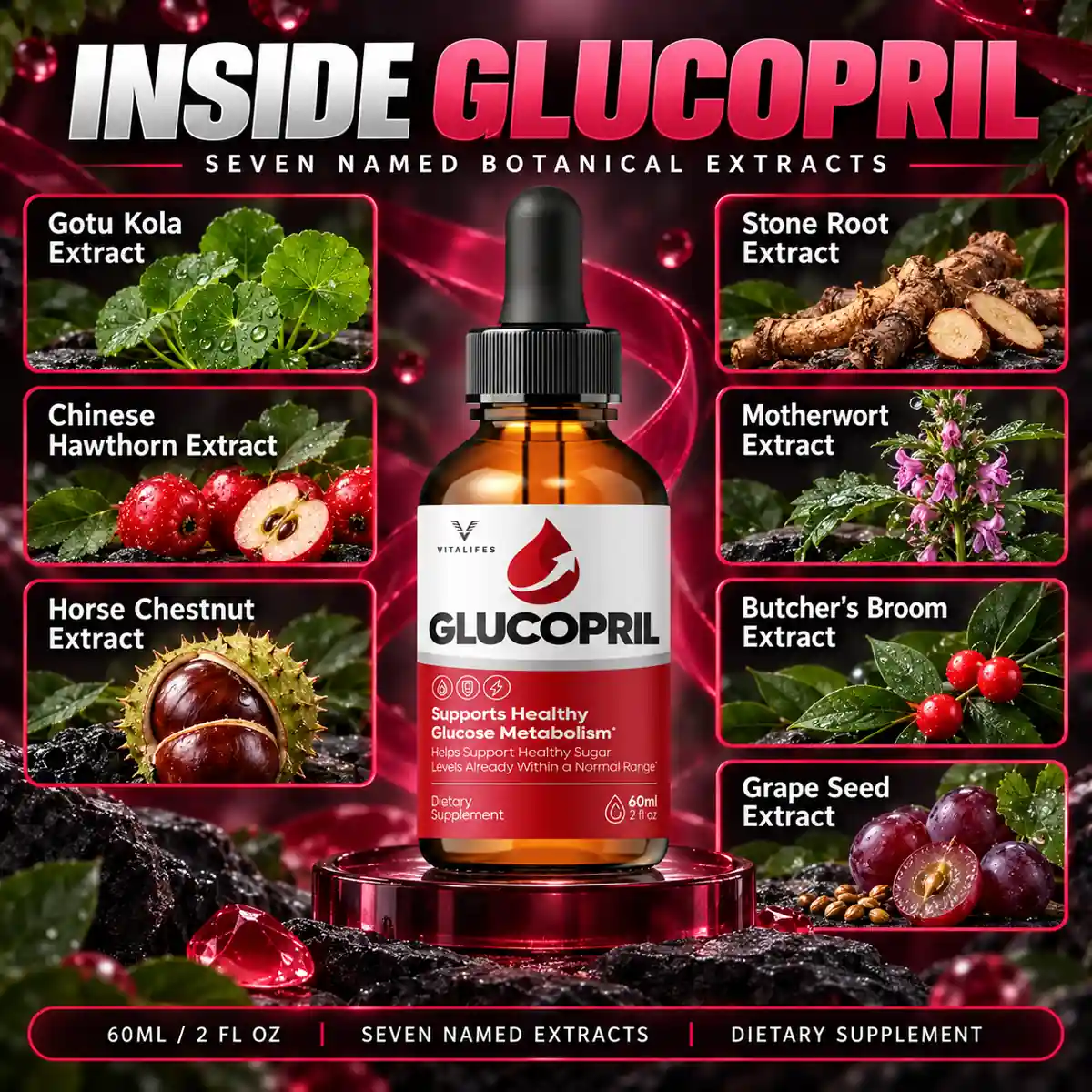
- All seven named extracts belong to the vein-and-capillary shelf, not the glycaemic one.
- There is no berberine, cinnamon, chromium, gymnema, bitter melon or banaba on this label.
- Two of the seven have been pointed at a blood sugar outcome in a trial, and both left it where they found it.
- The family does have real evidence. It is measured in millilitres of leg volume.
- No amount is printed for any of the seven, so nothing on this label can be compared with a trial dose directly.
The shelf these seven came from
Walk into a pharmacy anywhere in France, Germany or Italy and ask for something for heavy legs, and you will be handed a product built from this family. Not most of it. This exact family.
Chronic venous insufficiency is a real and common condition: valves in the leg veins stop closing properly, blood pools, the ankle swells by the end of the day and the skin around it changes over years. It has a well-developed botanical pharmacology built around compounds that reduce capillary permeability and improve venous tone, and the plants below are its standard repertoire.
The class even has a name in the literature. Cochrane’s 2020 review of phlebotonics gathered sixty-nine randomised trials of this whole family and concluded, at moderate certainty, that it slightly reduces oedema and slightly increases adverse events against placebo. That is a modest finding stated precisely, which is what a mature evidence base looks like.
| Plant | What it is traditionally given for | The measure its trials report |
|---|---|---|
| Gotu kola (Centella asiatica) | Capillary fragility, heavy legs, microangiopathy | Microcirculatory measures and ankle oedema |
| Chinese hawthorn (Crataegus) | Cardiac tone, circulation | Symptom scores in heart failure; blood pressure |
| Horse chestnut (Aesculus) | Venous insufficiency, leg swelling | Lower-leg volume in millilitres |
| Stone root (Collinsonia) | Haemorrhoids, varicose veins | Nothing. No human trial exists for the genus |
| Motherwort (Leonurus) | Palpitations, anxiety | Obstetric outcomes; uterine smooth muscle in the laboratory |
| Butcher's broom (Ruscus) | Heavy legs, venous symptoms | Leg volume and symptom scores |
| Grape seed (Vitis vinifera) | Capillary support, antioxidant use | Blood pressure; flow-mediated dilation |
Seven plants, one shelf. The right-hand column is what the published work actually counted, and six of the seven never counted a glucose reading at all.
Read that table's right-hand column and the pattern is unmissable. Millilitres of leg volume. Ankle circumference. Symptom scores about heaviness and aching. Capillary filtration rates. This is a family that has been measured carefully for forty years against a set of outcomes that has nothing to do with blood sugar.
How the set was assembled, and when
The combination is older than most of the people buying it. The horse chestnut comparison published in The Lancet in 1996 is the trial that made the family respectable in English-language medicine: 240 patients, 50 mg of aescin twice daily for twelve weeks, and a reduction in lower-leg volume of 43.8 ml against 46.7 ml for compression stockings. A plant extract performing within a few millilitres of the standard mechanical treatment is a genuinely striking result.
Butcher’s broom arrived through a different route, as one third of a fixed combination. A meta-analysis covering 10,246 subjects assessed 150 mg of the root extract alongside hesperidin methyl chalcone and vitamin C in a single capsule, which is how it is almost always studied and almost never sold on its own.
Gotu kola came in from the microcirculation literature. A 2013 systematic review of eight trials reports improved microcirculatory measures in people with venous insufficiency, most of the studies at unclear risk of bias, which is an honest summary of a small older literature.
Stone root and motherwort are the traditional members. Stone root has a long folk history in haemorrhoids and varicose veins and a published record that is close to empty. Motherwort belongs to the cardiac-tone tradition that hawthorn also comes from. Neither is there because a trial put it there, and a formulator assembling this family would include them for the same reason a pharmacist in 1985 would have.
The two that were pointed at glucose
Two of the seven have actually been taken into a trial with a blood sugar outcome attached, and the results are the most important thing on this page.
A randomised controlled trial published in 2025 gave 1,200 mg of Centella asiatica a day for six months to people with type 2 diabetes. In the adjusted analysis there was no between-group difference in HbA1c, no difference in fasting plasma glucose and no difference in LDL cholesterol. Six months, a substantial daily amount, and a clean negative.
A hawthorn trial in 79 people with type 2 diabetes gave 1,200 mg a day for sixteen weeks. Diastolic blood pressure fell, which is a real finding and was the paper’s headline. The trial reported no glycaemic benefit.
| The trial | What it gave | What it found |
|---|---|---|
| A 2025 randomised trial in type 2 diabetes | 1,200 mg of gotu kola a day for six months | No between-group difference in HbA1c, fasting plasma glucose or LDL cholesterol |
| A hawthorn trial in 79 people with type 2 diabetes | 1,200 mg a day for sixteen weeks | Diastolic blood pressure fell; no glycaemic benefit reported |
| The Lancet stocking comparison, 240 patients | 50 mg of aescin twice daily for twelve weeks | Lower-leg volume fell 43.8 ml, against 46.7 ml for compression stockings |
| A meta-analysis of 10,246 subjects | 150 mg of butcher's broom root extract per capsule, with two companions | Leg volume and venous symptoms improved |
Two of these four pointed a plant on this label at a blood sugar outcome. The other two are what this family is normally measured on.
Grape seed is the near-miss worth mentioning. It has been studied in people at risk of type 2 diabetes at 300 mg a day for twelve weeks, and what moved was blood pressure rather than any glucose measure. That is three plants from this label taken into metabolic research and three results about the cardiovascular system.
Read the whole GlucoPril ingredient list before weighing one plant
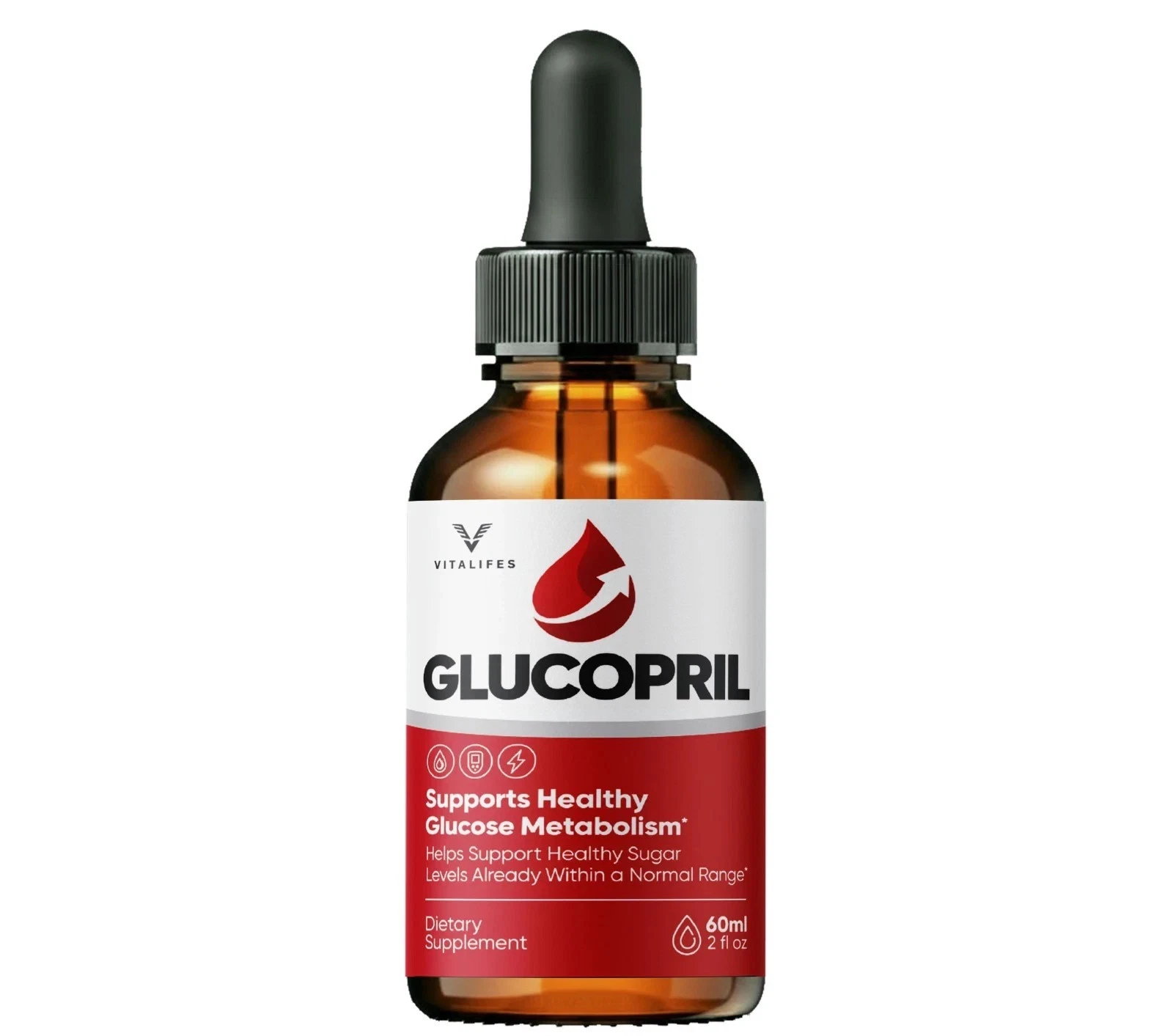
Seven extracts named on the seller’s own graphic, with the amount each one’s published trials used printed beside it, and no amount printed on the label for any of them.
Price at checkout · three bottles is the pack most buyers take · money-back guarantee as the listing prints it
Order GlucoPril On The Official WebsiteTwo drops a day after a meal · 60 ml a bottle · lot GLU-26/GO-3914
Why a formulator reaches for this family anyway
There is a coherent story behind this combination, and it is worth stating properly rather than dismissing, because it is the reason the bottle exists.
Sustained high blood glucose damages small blood vessels. That is not a marketing claim, it is the mechanism behind diabetic retinopathy, nephropathy and peripheral neuropathy, and it is why people with long-standing diabetes have their eyes and their feet checked. Microvascular damage is the central complication of the condition.
So a formulator can reason: this family supports small blood vessels, small blood vessels are where the damage happens, therefore this family belongs in a product aimed at people worried about their readings. Two of the gotu kola trials were run specifically in diabetic microangiopathy, which gives the reasoning a real anchor.
The gap in the argument is the direction of travel. Supporting a vessel that high glucose has damaged is a different proposition from changing the glucose. The first is plausible and partly evidenced; the second is what the front of a bottle marked healthy glucose metabolism invites a reader to assume, and it is not what any of this research measured.
- High glucose damages small vessels. Well established.
- This plant family has evidence for supporting small vessels. Modest, and real.
- Therefore the family is relevant to people with glucose problems. Arguable.
- Therefore the family affects glucose. This step does not follow, and the two trials that tested it directly found that it does not.
What this means for somebody holding the bottle
Three practical conclusions, and none of them is that the product is worthless.
If what you actually want is a supplement aimed at a glucose reading, this is the wrong shelf and no amount of front-of-pack language changes that. The ingredients with pooled evidence in that space are not in this bottle.
If heavy legs, ankle swelling or general circulatory complaints are the real story and the glucose worry came second, the family on this label is the one European pharmacy has used for that purpose for decades. That is a genuine point in its favour and it is almost never made on the front of the box.
And in either case the amounts are not printed, so no trial on this page describes what is in the liquid. The trials ran at 50 mg to 1,200 mg a day of single standardised extracts. Two drops of a seven-extract blend is a different order of magnitude.
This is a vein-and-capillary formula sold on a glucose claim, and knowing that changes what it is reasonable to expect from it.
Four questions worth asking of any botanical list
None of this is specific to one brand. The same four questions sort any shelf in about two minutes.
- Which clinical tradition do these plants come from? Search one of them plus the words randomised trial and read what the outcome measure was.
- Do the ingredients and the front-of-pack claim belong to the same tradition? This is the check almost nobody runs and it catches the most.
- Is an amount printed for each one? Without it no comparison with any trial is possible.
- If the plants were studied for something else, is that something you actually want? Sometimes the answer is yes, and then the mismatch stops mattering.
On this bottle the answers run: the venous shelf, no, no, and possibly. The fourth is the one only the buyer can answer, which is why the page on who it suits takes it seriously rather than treating the mismatch as the end of the conversation.
A dietary supplement for healthy adults of 18 and over, not a medicine and not FDA-approved. The two sentences printed on the front cap everything said about it: supports healthy glucose metabolism, and helps support healthy sugar levels already within a normal range. Nothing on this page moves that ceiling in either direction. Diabetes is diagnosed and managed by a clinician, and the side effects page covers the interactions worth raising before a first bottle.
References
- Martinez-Zapata MJ, Vernooij RW, Simancas-Racines D, et al. Phlebotonics for venous insufficiency. Cochrane Database Syst Rev. 2020;11(11):CD003229. PMID 33141449. Sixty-nine randomised trials; moderate-certainty evidence that this whole class reduces oedema slightly and slightly increases adverse events. https://pubmed.ncbi.nlm.nih.gov/33141449/
- Diehm C, Trampisch HJ, Lange S, Schmidt C. Comparison of leg compression stocking and oral horse-chestnut seed extract therapy in patients with chronic venous insufficiency. Lancet. 1996;347(8997):292-4. PMID 8569363. Dose: dried extract standardised to 50 mg aescin twice daily for 12 weeks in 240 patients; lower-leg volume fell 43.8 ml, against 46.7 ml for compression stockings. https://pubmed.ncbi.nlm.nih.gov/8569363/
- Chong NJ, Aziz Z. A systematic review of the efficacy of Centella asiatica for improvement of the signs and symptoms of chronic venous insufficiency. Evid Based Complement Alternat Med. 2013;2013:627182. PMID 23533507. Eight trials; microcirculatory measures improved, most studies at unclear risk of bias. https://pubmed.ncbi.nlm.nih.gov/23533507/
- Boyle P, Diehm C, Robertson C. Meta-analysis of clinical trials of Cyclo 3 Fort in the treatment of chronic venous insufficiency. Int Angiol. 2003;22(3):250-62. PMID 14612852. Dose: Ruscus aculeatus root extract 150 mg with hesperidin methyl chalcone 150 mg and ascorbic acid 100 mg per capsule; 10,246 subjects. https://pubmed.ncbi.nlm.nih.gov/14612852/
- Walker AF, Marakis G, Simpson E, et al. Hypotensive effects of hawthorn for patients with diabetes taking prescription drugs: a randomised controlled trial. Br J Gen Pract. 2006;56(527):437-43. PMID 16762125. Dose: 1,200 mg hawthorn extract daily for 16 weeks in 79 people with type 2 diabetes; diastolic blood pressure fell, and the trial did not report a glycaemic benefit. https://pubmed.ncbi.nlm.nih.gov/16762125/
- Tawanwongsri W, Mordmuang A, Phenwan T, Siri-Archawawat D. Efficacy and safety of Centella asiatica (L.) Urb. [Apiaceae] as a dietary supplement for glycemic control and lipid regulation in patients with type 2 diabetes: a randomized controlled trial in Thailand. Front Pharmacol. 2025;16:1680647. PMID 41383475. Dose: 1,200 mg/day for 6 months; adjusted analysis found no between-group difference in HbA1c, fasting plasma glucose or LDL-C. https://pubmed.ncbi.nlm.nih.gov/41383475/