GlucoPril Official Website › Blog › The Usual Names
The Blood Sugar Aisle’s Usual Names, And Why None Are Here
Ask a supplement shop for something for blood sugar and you will be handed berberine, cinnamon, chromium, gymnema, bitter melon or banaba. Those six built the category. None of them is on this bottle. Here is what the pooled trials on each of them actually found, told honestly and in numbers, and what is named on the label in their place.
- Berberine and cinnamon each have an umbrella meta-analysis behind them, a review of reviews, reporting reductions in fasting glucose and HbA1c.
- Chromium, gymnema, bitter melon and banaba have thinner or shakier records. Some of the pooled results are large on paper and come with very high heterogeneity or a design that compares people with their own starting point.
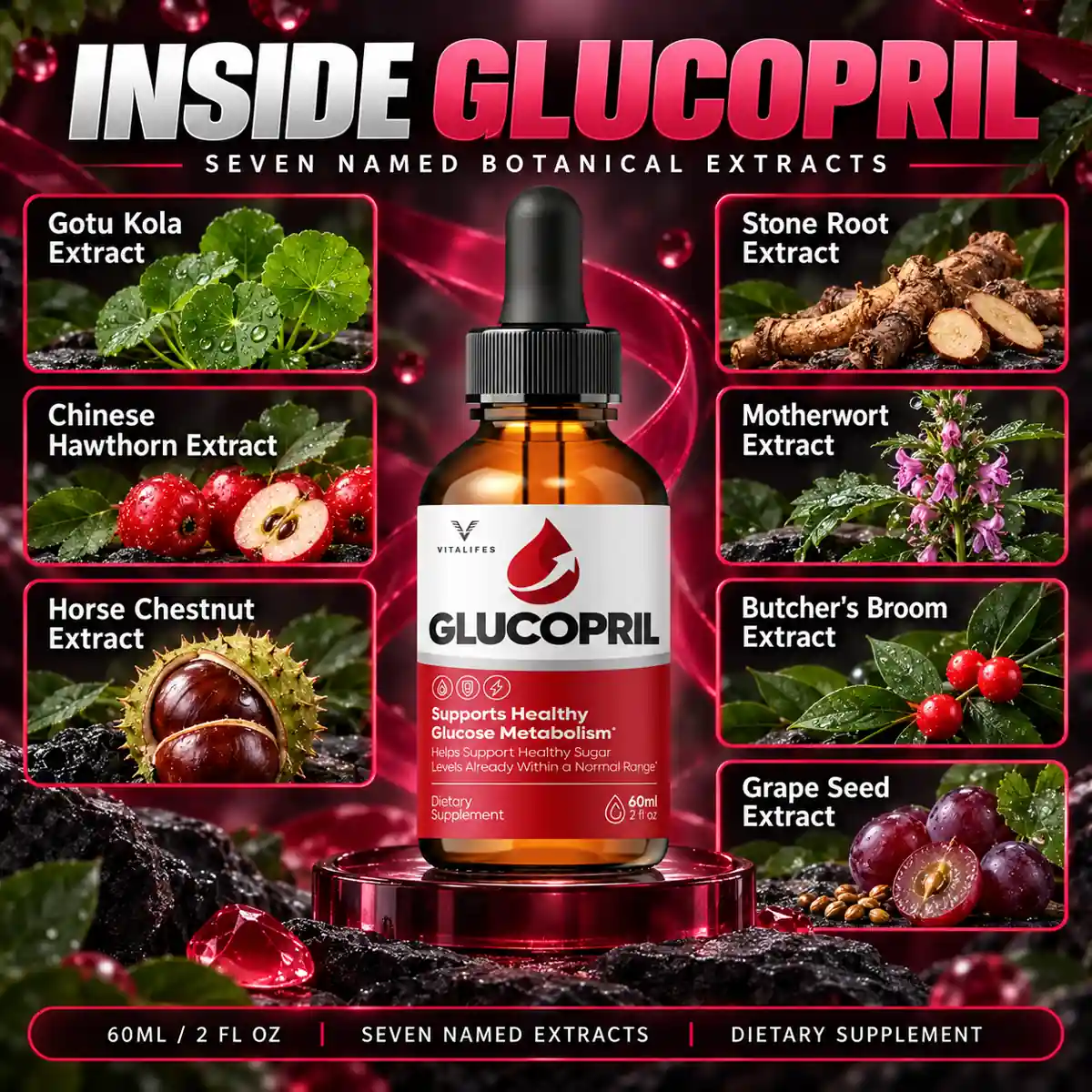
- None of the six is named on this bottle. What is named instead is gotu kola, Chinese hawthorn, horse chestnut, stone root, motherwort, butcher’s broom and grape seed.
- Three of the seven label plants have glucose or diabetes-population trials. Gotu kola and Chinese hawthorn each have one in people with type 2 diabetes, and neither reports a glucose benefit; grape seed has a pooled result of 2.01 mg/dL on fasting glucose and no change in HbA1c.
- Berberine also carries an interaction question with metformin that the seven plants on this label do not raise in the same way. Category names are not a substitute for reading the list.
How a shelf earns its name
Nobody sets out to build a category by accident. Somebody notices that an ingredient has been tested against a glucose number, more than once, and that the results lean the same way, and the next company puts that ingredient on a bottle and calls the bottle a blood sugar formula. Repeat that a few dozen times and you have an aisle. For blood sugar the ingredients that did that work are the six in the title: berberine, cinnamon, chromium, gymnema, bitter melon and banaba.
This bottle sits in the same conversation. The front says supports healthy glucose metabolism and helps support healthy sugar levels already within a normal range, which is the aisle’s language, word for word. The seller’s ingredient graphic, though, names seven different plants. It is worth putting the two lists side by side, not to score the bottle but because a reader deserves to know which shelf the contents actually came from. The article on the seven vein plants covers where they come from. This one covers what they are not.
We will take the two best-documented names first, then the four that are patchier, then the label.
Berberine, and a very large pooled result
Berberine is an alkaloid found in the roots and bark of several plants, notably barberry species, and it is the ingredient most often compared with a prescription diabetes drug. That comparison is not marketing; it comes from the way it behaves in cells, and we will come back to it in the caution section.
The strongest single summary is a 2024 umbrella meta-analysis in Clinical Therapeutics. An umbrella review does not go back to the original trials; it gathers the existing meta-analyses of them, on the theory that when several groups have pooled the same literature and disagree, somebody should pool the poolers. The authors searched five databases for meta-analyses published up to April 2023 and reported that berberine supplementation reduced fasting blood glucose and HbA1c, along with insulin resistance, insulin, and several inflammatory markers. For fasting glucose the effect sizes were −0.77 (95% CI −0.90 to −0.63) on one scale and −0.65 on the standardised one; for HbA1c it was −0.57. Those are the paper’s own effect-size units, and the abstract does not translate them into mg/dL, so we will not pretend to.
A more concrete number comes from a 2022 meta-analysis of randomised trials in type 2 diabetes: 37 studies, 3,048 patients. Berberine lowered fasting plasma glucose by 0.82 mmol/L (roughly 15 mg/dL, using the usual factor of 18), HbA1c by 0.63 percentage points, and the two-hour post-load glucose by 1.16 mmol/L. The authors also found the effect was tied to where people started: the higher the baseline glucose and HbA1c, the bigger the drop. Adverse events were not more common than in the comparison arms, and hypoglycaemia was not significantly more common either.
Two reading notes. The first is that these were people with type 2 diabetes, many of them already on other treatment, so the numbers describe a population with glucose to lose. The second is that a dependence on baseline is exactly what you would expect when a substance nudges a regulated system: if you start in a comfortable place there is not much room to move. Keep that second point in mind, because it applies to every ingredient in this article and to the sentence on the front of this bottle.
Cinnamon, and one number that does not sit still
Cinnamon is the friendlier-looking half of the pair, and its record is similarly built from reviews. A 2023 umbrella meta-analysis in Diabetology & Metabolic Syndrome pooled 11 meta-analyses of randomised trials in people with type 2 diabetes or polycystic ovary syndrome. It reported fasting plasma glucose lower by 10.93 mg/dL (95% CI −16.22 to −5.65), insulin lower, insulin resistance lower, and HbA1c lower by 0.10 percentage points (95% CI −0.17 to −0.03).
Set those two headline figures next to each other. A drop of nearly 11 mg/dL in fasting glucose is a visible change on a meter. A drop of 0.10 in HbA1c, which reflects roughly three months of average glucose, is so small that a lab’s own measurement noise sits close to it. Both can be true of the same literature, because the trials differ in length, dose, preparation and starting point, and the abstract does not reconcile them. The honest summary is that the direction is consistent and the size is modest and hard to pin down, which is a fair description of a lot of supplement science.
Cinnamon also carries its own footnote. Cassia cinnamon contains coumarin, up to about one per cent by weight, and heavy use can push intake past the tolerable daily limit. A four-way crossover study in 24 healthy volunteers gave the same 12 mg of coumarin as an isolated capsule, as cinnamon capsules, as cinnamon tea and in rice pudding. The share absorbed from cinnamon powder in capsules was 56.0 per cent against 62.8 per cent for the pure compound, so the plant matrix does not switch the concern off. It is the kind of detail that never appears on a bottle’s front and matters if you take a lot of it every day for months.
Chromium, gymnema, bitter melon and banaba
The other four names have literatures that are real but rougher. It helps to see them in one place, with the caveat that goes with each number, rather than as four separate promises.
| Ingredient | What the pooled record reports | The catch printed in the same abstract |
|---|---|---|
| Chromium | 28 trials in type 2 diabetes: fasting glucose −19.00 mg/dL, HbA1c −0.71 points (2020 meta-analysis) | Heterogeneity for fasting glucose of 99.8 per cent, meaning the trials disagree wildly with one another |
| Gymnema | 10 studies, 419 people: reductions in fasting glucose, post-meal glucose and HbA1c (2021 meta-analysis) | The comparison is after-treatment against each person’s own baseline, and heterogeneity runs from 80 to 99 per cent |
| Bitter melon | The 2012 Cochrane review found 4 trials and 479 people: no significant difference against placebo. A 2019 meta-analysis of 10 trials and 1,045 people reported a fasting glucose drop of 0.72 mmol/L | Cochrane: insufficient evidence, high risk of bias, no two preparations alike. The 2019 authors rate their own evidence low to very low quality |
| Banaba | A narrative review covering folk use since at least 1940 and corosolic acid studies, including a reported blood sugar fall within 60 minutes of pure corosolic acid | A review of the literature, not a pooled analysis, spanning animal, human and in-vitro work |
Sources: chromium, PMID 32730903; gymnema, PMID 34467577; bitter melon, PMIDs 22895968 and 30385422; banaba, PMID 22095937.
The chromium row is the one to look at twice. A 19 mg/dL fall in fasting glucose sounds like a serious drug effect. But the same abstract reports that the trials behind it vary so much from one another that a single average is hardly a description of any of them. The number is not false; it just describes nothing in particular. Gymnema’s before-and-after design is a problem the article on fasting readings spends a whole section on: people are not the same person twice, so improvement from baseline is not the same as improvement against a control.
Bitter melon is a fair picture of how a category’s evidence can look from two vantage points. The Cochrane authors could not pool anything, because no two trials tested the same preparation twice, and concluded there was insufficient evidence. Seven years later another group pooled ten trials and reported a real average effect while telling the reader in the same paragraph that the underlying quality was low to very low. Neither of those is a scandal. It is what a young literature on a variable plant looks like.
Read the whole GlucoPril ingredient list before weighing one plant
Seven extracts named on the seller’s own graphic, with the amount each one’s published trials used printed beside it, and no amount printed on the label for any of them.
Price at checkout · three bottles is the pack most buyers take · money-back guarantee as the listing prints it
Order GlucoPril On The Official WebsiteTwo drops a day after a meal · 60 ml a bottle · lot GLU-26/GO-3914
What is on this label instead
The seven names on the seller’s graphic are gotu kola, Chinese hawthorn, horse chestnut, stone root, motherwort, butcher’s broom and grape seed. None of the six category names above appears among them, and the label offers no explanation for the choice; it gives no amounts either, which is why the site prints the doses the trials used rather than a figure that does not exist. Marketplace reports describe all seven sitting inside a blend of about 121 mg in total.
Three of the seven have a glucose or diabetes-population trial behind them, which is more than most botanicals on any shelf can claim, and it is worth reading what those trials reported.
Chinese hawthorn. A 2006 randomised trial in Reading, England gave 79 people with type 2 diabetes either 1,200 mg of hawthorn extract or placebo every day for 16 weeks. Diastolic blood pressure fell more in the hawthorn group, ending at 83.0 mmHg against 85.0 for placebo, while systolic pressure showed no group difference. The abstract reports no herb-drug interaction and does not report a glucose result. The bigger hawthorn trial is SPICE, which randomised 2,681 people with heart failure to 900 mg a day of a specific extract or placebo for 24 months and missed its primary endpoint (hazard ratio 0.95, 95% CI 0.82 to 1.10). The site’s hawthorn article takes that literature apart properly.
Gotu kola. A 2025 trial from Thailand gave 1,200 mg a day of a Centella asiatica extract or placebo to people with type 2 diabetes for six months. Seventy completed. The unadjusted comparison of HbA1c looked different between groups, but in the prespecified adjusted analysis there were no between-group differences in HbA1c, fasting plasma glucose or LDL cholesterol, and the authors concluded it was safe but did not change glycaemic or lipid outcomes.
Grape seed. The third is a pooled analysis rather than a single trial. A 2020 meta-analysis of 50 randomised trials reported that grape seed extract lowered fasting plasma glucose by 2.01 mg/dL (95% CI −3.14 to −0.86) and did not change HbA1c. Two mg/dL is about two per cent of a fasting reading of 100, and the paper carries a 2022 erratum, though no retraction. It is a real result in the right direction and a very small one.
| Label plant | The glucose-relevant evidence | What it measured | What it reported |
|---|---|---|---|
| Chinese hawthorn | 79 people with type 2 diabetes, 1,200 mg a day, 16 weeks, 2006 | Blood pressure, with fasting bloods drawn | Diastolic fell more than on placebo; no systolic difference; no glucose result in the abstract |
| Gotu kola | 70 completers with type 2 diabetes, 1,200 mg a day, 6 months, 2025 | HbA1c, fasting glucose, LDL cholesterol | No adjusted difference on any of the three |
| Grape seed | 50 randomised trials pooled, 2020 | Fasting glucose, HbA1c, lipids, CRP | Fasting glucose −2.01 mg/dL; HbA1c unchanged |
Three of the seven, with a glucose benefit reported by none of the first two and a very small one by the third. For the other four (horse chestnut, stone root, motherwort and butcher’s broom) we found no glucose trial in PubMed.
What a comparison like this cannot tell you
It would be easy to read the last two sections as a scoreboard, six names with glucose results against seven with none, and to conclude the bottle loses. That is too neat, and it is worth saying why.
First, the populations differ. Every glucose number above comes from people with type 2 diabetes, prediabetes or a related condition, treated for weeks or months. The sentence on this bottle is about sugar levels already within a normal range, and what that phrase means in numbers is a separate question with a much smaller room to move in. An effect measured in people with high readings does not simply transfer to people with normal ones.
Second, an umbrella review inherits every weakness of the reviews it gathers. If the trials underneath share the same biases, pooling them again does not remove those biases; it can make them look official. The berberine and cinnamon papers are the best summaries available, and they are still summaries of trials that were often small, short and run by groups with an interest in the answer.
Third, “statistically significant” and “worth taking” are different sentences. A 0.10-point HbA1c change can clear a significance threshold and still not be something a person would notice or a clinician would act on.
And fourth, absence of a glucose trial is not evidence of no effect. It is just absence. Nothing here says the seven plants on this label do nothing to glucose; it says nobody has published the trial that would show it either way for most of them. What we can say is that the honest description of the label is a seven-plant circulation blend with a glucose sentence on the front, and that the front should not be allowed to borrow the results of a shelf it does not stock.
The caution that goes with the good numbers
None of this is an argument that the bottle should have contained berberine. Berberine is the ingredient in the aisle with the clearest pharmacology, and that cuts both ways. A 2015 study of berberine and metformin found that berberine inhibited two transporters, OCT1 and OCT2, that carry metformin into cells, with IC50 values of 7.28 and 11.3 micromolar in cultured cells, and that giving berberine to rats raised metformin’s plasma exposure and slowed its clearance. That work was in cells and rats, not people, and it does not tell you what happens at a supplement dose in a patient. It does tell you why an ingredient that acts on glucose is not something to add on top of a glucose-lowering prescription without telling whoever prescribes it.
The seven plants on this label bring their own cautions, set out on the side effects page, and none is the same as berberine’s. That is not a virtue and not a fault. It is just a different list, and the reason to read the ingredient panel before the front.
Three questions before buying on a category name
- Which of the named ingredients has a glucose trial at all? Search the plant name plus “HbA1c” or “fasting glucose” on PubMed. It takes two minutes per name and it is the whole method this article used.
- Was that trial in people like you? A result in type 2 diabetes is not a result in someone whose readings are normal, and the reverse is also true.
- Does anything you take already act on glucose? If so, say so to a prescriber before adding another thing that does. That is the one question on this list that is not optional.
A dietary supplement for healthy adults of 18 and over, not a medicine and not FDA-approved. The two sentences on the front are the ceiling on everything this website says about it, and nothing here is a recommendation to start or stop berberine, cinnamon or any other supplement. Diabetes is diagnosed and managed by a clinician.
References
- Nazari A, Ghotbabadi ZR, Kazemi KS, Metghalchi Y, Tavakoli R, Rahimabadi RZ, et al. The Effect of Berberine Supplementation on Glycemic Control and Inflammatory Biomarkers in Metabolic Disorders: An Umbrella Meta-analysis of Randomized Controlled Trials. Clin Ther. 2024;46(2):e64-e72. PMID 38016844. https://pubmed.ncbi.nlm.nih.gov/38016844/
- Xie W, Su F, Wang G, Peng Z, Xu Y, Zhang Y, et al. Glucose-lowering effect of berberine on type 2 diabetes: A systematic review and meta-analysis. Front Pharmacol. 2022;13:1015045. PMID 36467075. https://pubmed.ncbi.nlm.nih.gov/36467075/
- Zarezadeh M, Musazadeh V, Foroumandi E, Keramati M, Ostadrahimi A, Mekary RA. The effect of cinnamon supplementation on glycemic control in patients with type 2 diabetes or with polycystic ovary syndrome: an umbrella meta-analysis on interventional meta-analyses. Diabetol Metab Syndr. 2023;15:127. PMID 37316893. https://pubmed.ncbi.nlm.nih.gov/37316893/
- Abraham K, Pfister M, Wohrlin F, Lampen A. Relative bioavailability of coumarin from cinnamon and cinnamon-containing foods compared to isolated coumarin: a four-way crossover study in human volunteers. Mol Nutr Food Res. 2011;55(4):644-53. PMID 21462332. https://pubmed.ncbi.nlm.nih.gov/21462332/
- Asbaghi O, Fatemeh N, Mahnaz RK, Ehsan G, Elham E, Behzad N, et al. Effects of chromium supplementation on glycemic control in patients with type 2 diabetes: a systematic review and meta-analysis of randomized controlled trials. Pharmacol Res. 2020;161:105098. PMID 32730903. https://pubmed.ncbi.nlm.nih.gov/32730903/
- Devangan S, Varghese B, Johny E, Gurram S, Adela R. The effect of Gymnema sylvestre supplementation on glycemic control in type 2 diabetes patients: A systematic review and meta-analysis. Phytother Res. 2021;35(12):6802-6812. PMID 34467577. https://pubmed.ncbi.nlm.nih.gov/34467577/
- Ooi CP, Yassin Z, Hamid TA. Momordica charantia for type 2 diabetes mellitus. Cochrane Database Syst Rev. 2012;(8):CD007845. PMID 22895968. https://pubmed.ncbi.nlm.nih.gov/22895968/
- Peter EL, Kasali FM, Deyno S, Mtewa A, Nagendrappa PB, Tolo CU, et al. Momordica charantia L. lowers elevated glycaemia in type 2 diabetes mellitus patients: Systematic review and meta-analysis. J Ethnopharmacol. 2019;231:311-324. PMID 30385422. https://pubmed.ncbi.nlm.nih.gov/30385422/
- Stohs SJ, Miller H, Kaats GR. A review of the efficacy and safety of banaba (Lagerstroemia speciosa L.) and corosolic acid. Phytother Res. 2012;26(3):317-24. PMID 22095937. https://pubmed.ncbi.nlm.nih.gov/22095937/
- Kwon M, Choi YA, Choi MK, Song IS. Organic cation transporter-mediated drug-drug interaction potential between berberine and metformin. Arch Pharm Res. 2015;38(5):849-56. PMID 25359200. https://pubmed.ncbi.nlm.nih.gov/25359200/
- Walker AF, Marakis G, Simpson E, Hope JL, Robinson PA, Hassanein M, et al. Hypotensive effects of hawthorn for patients with diabetes taking prescription drugs: a randomised controlled trial. Br J Gen Pract. 2006;56(527):437-43. PMID 16762125. https://pubmed.ncbi.nlm.nih.gov/16762125/
- Holubarsch CJ, Colucci WS, Meinertz T, Gaus W, Tendera M; SPICE trial study group. The efficacy and safety of Crataegus extract WS 1442 in patients with heart failure: the SPICE trial. Eur J Heart Fail. 2008;10(12):1255-63. PMID 19019730. https://pubmed.ncbi.nlm.nih.gov/19019730/
- Asbaghi O, Nazarian B, Reiner Z, Amirani E, Kolahdooz F, Chamani M, et al. The effects of grape seed extract on glycemic control, serum lipoproteins, inflammation, and body weight: A systematic review and meta-analysis of randomized controlled trials. Phytother Res. 2020;34(2):239-253. (Erratum: Phytother Res. 2022;36(3):1413, PMID 35322496.) PMID 31880030. https://pubmed.ncbi.nlm.nih.gov/31880030/
- Tawanwongsri W, Mordmuang A, Phenwan T, Siri-Archawawat D. Efficacy and safety of Centella asiatica (L.) Urb. [Apiaceae] as a dietary supplement for glycemic control and lipid regulation in patients with type 2 diabetes: a randomized controlled trial in Thailand. Front Pharmacol. 2025;16:1680647. PMID 41383475. https://pubmed.ncbi.nlm.nih.gov/41383475/